
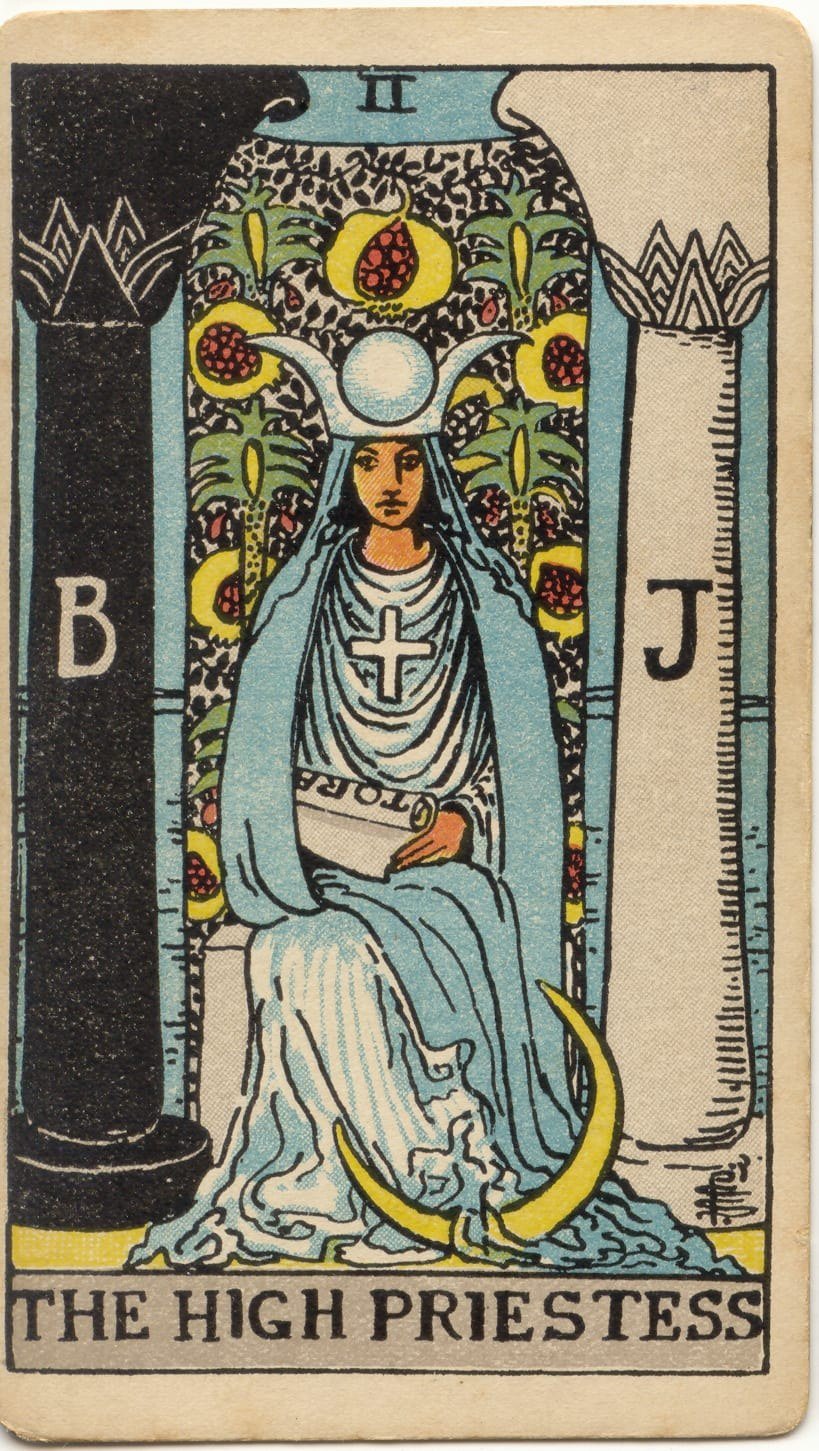
The High Priestess sits still while the rest of the major arcana gets on with its business. She is seated between two pillars, a veil patterned with pomegranates hanging behind her, a scroll resting in her lap, and a crown on her head that carries the full moon between two horns. Where the Magician acts and the Fool leaps, she waits. Her card is about what is known but not said, felt but not yet proven, true but not yet ready to surface.
She is the second card of the major arcana, numbered two, and her stillness is the point. Not every question needs action. Some need the quieter work of noticing.
The picture: veil, pillars, and moon crown
Read the image the way you would read a room. The two pillars are marked B and J in the Rider-Waite-Smith deck, for Boaz and Jachin, the pillars of Solomon’s temple: one dark, one light, with the Priestess seated exactly between them. She is the balance point, not a partisan of either side. Behind her hangs the veil, embroidered with pomegranates, marking the boundary between the seen and the unseen. The scroll in her lap, lettered TORA, is partly covered by her robe: knowledge that is present but not fully revealed, even to her.
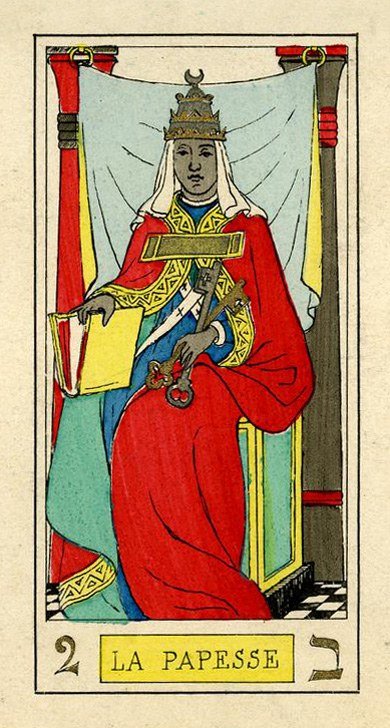
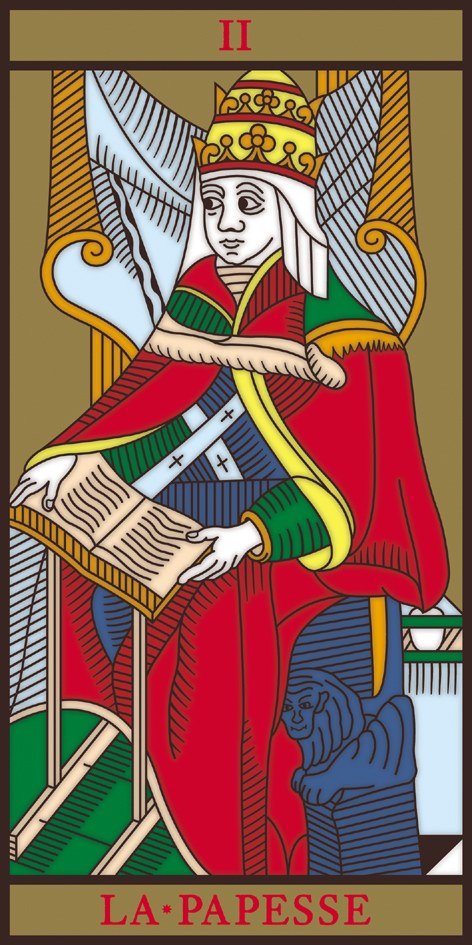
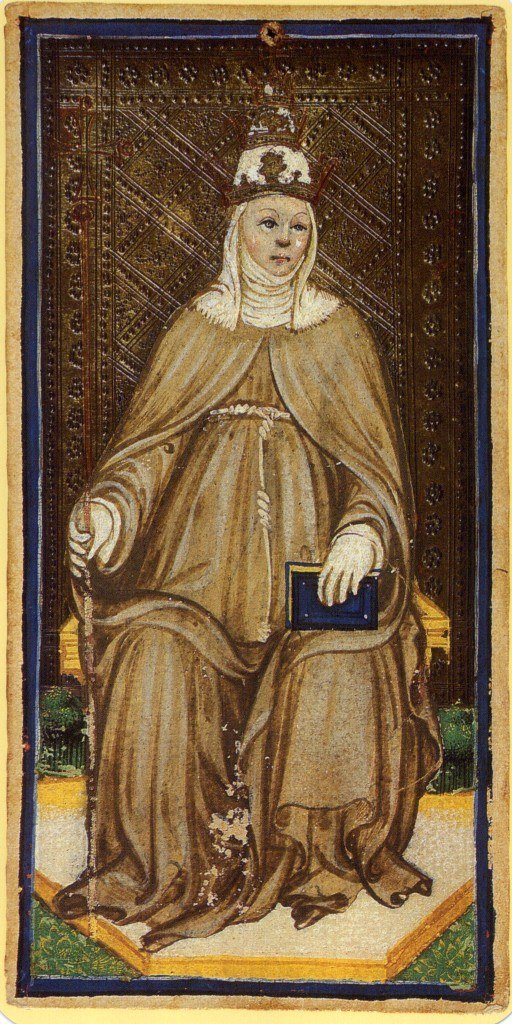
Above all this sits the crown, her most recognizable feature. A full moon rests between two crescent horns, tying her to lunar cycles, to tides, to everything that moves in rhythm rather than in straight lines. Older decks show her as La Papesse, the Popess, a seated female pope with a triple crown. The Rider-Waite-Smith version replaced the papal imagery with the lunar crown, but the meaning carried over: an authority that does not come from any institution.
Intuition is not assumption
The High Priestess is the intuition card, and that word needs care. Intuition, in the sense this card means it, is not a hunch you act on immediately. It is the slower signal underneath the noise: the read on a situation that forms before you can explain it. Assumption is the opposite motion. Assumption fills in the blanks quickly and calls it knowing. The Priestess asks you to tell the two apart.
In practice the difference is patience. If you draw this card and feel sure you know what is going on, the card is usually suggesting the opposite: wait, watch, let the picture develop. If you draw it and feel confused, the confusion itself is the message. The information is still behind the veil, and no amount of pulling at the fabric will bring it forward early. For readers comparing deck traditions, Rider-Waite versus Thoth shows how differently this card can be drawn.
When she appears in a reading
The High Priestess turns up most often in readings about hidden information. Someone is not saying everything. A situation has a layer you have not seen yet. Something is developing that is not ready to be named. The card does not tell you to dig. It tells you to notice that digging is premature, and to keep your attention open in the meantime.
She also appears in readings about timing. The veil lifts on its own schedule. Pushing for an answer now, demanding the reveal, tends to produce the worst version of the truth: partial, distorted, or simply wrong. The card’s counsel is to let things ripen. If you keep a record of your readings, you will often find that a Priestess reading makes complete sense three weeks later. Keeping a tarot journal is the practical way to catch those delayed landings.
Reversed: the unheeded signal
Reversed, the High Priestess often describes intuition that was available and ignored. You knew, and you overrode it. The card can also mark a situation where secrecy has curdled: what began as privacy has become withholding, and the veil is no longer protecting anything. In readings about other people, it sometimes points to information being deliberately kept back, though the card alone is thin evidence for that. Pair it with what else is on the table before drawing conclusions.
As with every reversal, the change is one of degree and direction rather than a flip into an opposite. Whether to use reversed cards at all is a real choice readers make differently, and this card is a good test case for deciding.
Reading with her
The High Priestess rewards a particular style of question. “What am I not seeing?” works better than “what should I do?” So does “what needs more time?” She pairs well with reflective spreads and poorly with urgent ones; asking her to settle a decision by Friday is asking the wrong card. In a spread about a relationship, she often marks the part of the dynamic neither person is naming. In a spread about work, she can mark office knowledge that has not been shared with you yet, or your own unacknowledged read on a colleague.
Her deepest lesson is the simplest one. Some knowledge arrives quietly, on its own schedule, and the work is to be still enough to receive it. The moon does not hurry, and neither does she.
The lunar connection
The moon crown is not decoration. The moon governs the card’s whole tempo: waxing and waning, visible and hidden, pulling at things from a distance. People who work with lunar timing often find this card appearing around the full moon, when what was hidden tends to show itself, or the new moon, when intentions are still forming. You do not need a lunar practice to read the card well, but the association explains her patience. She keeps moon time, and moon time is not clock time.
For a grounded approach to using cards this way, as mirrors rather than oracles, tarot for self-reflection lays out the method without any mystique.