
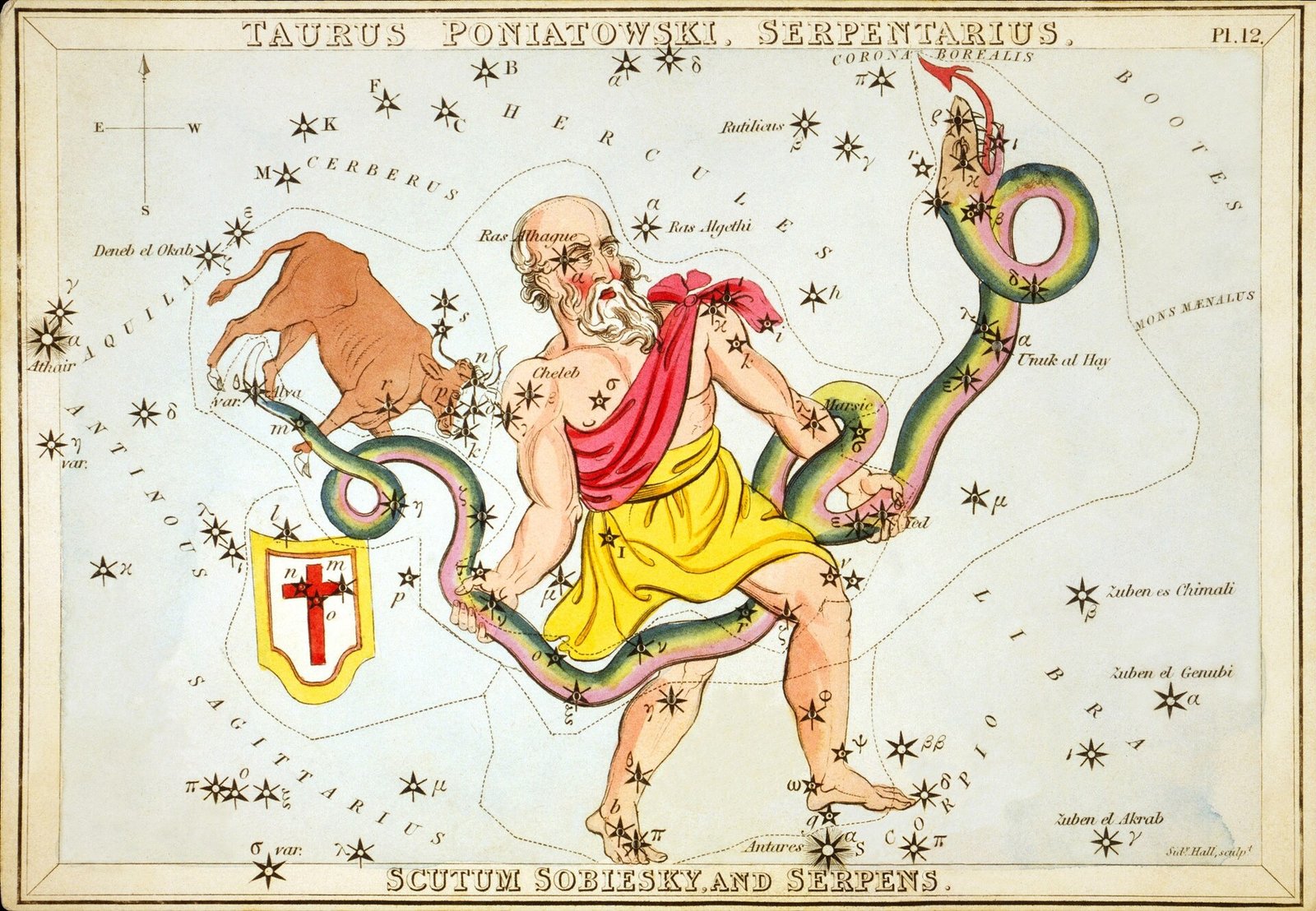
Every few years a headline announces that NASA has discovered a thirteenth zodiac sign, Ophiuchus, and that everyone’s sign has changed. The claim resurfaces because it contains a real astronomical fact wrapped in a misunderstanding. Here is the fact, the misunderstanding, and why astrologers are not updating the wheel.
The real astronomical fact
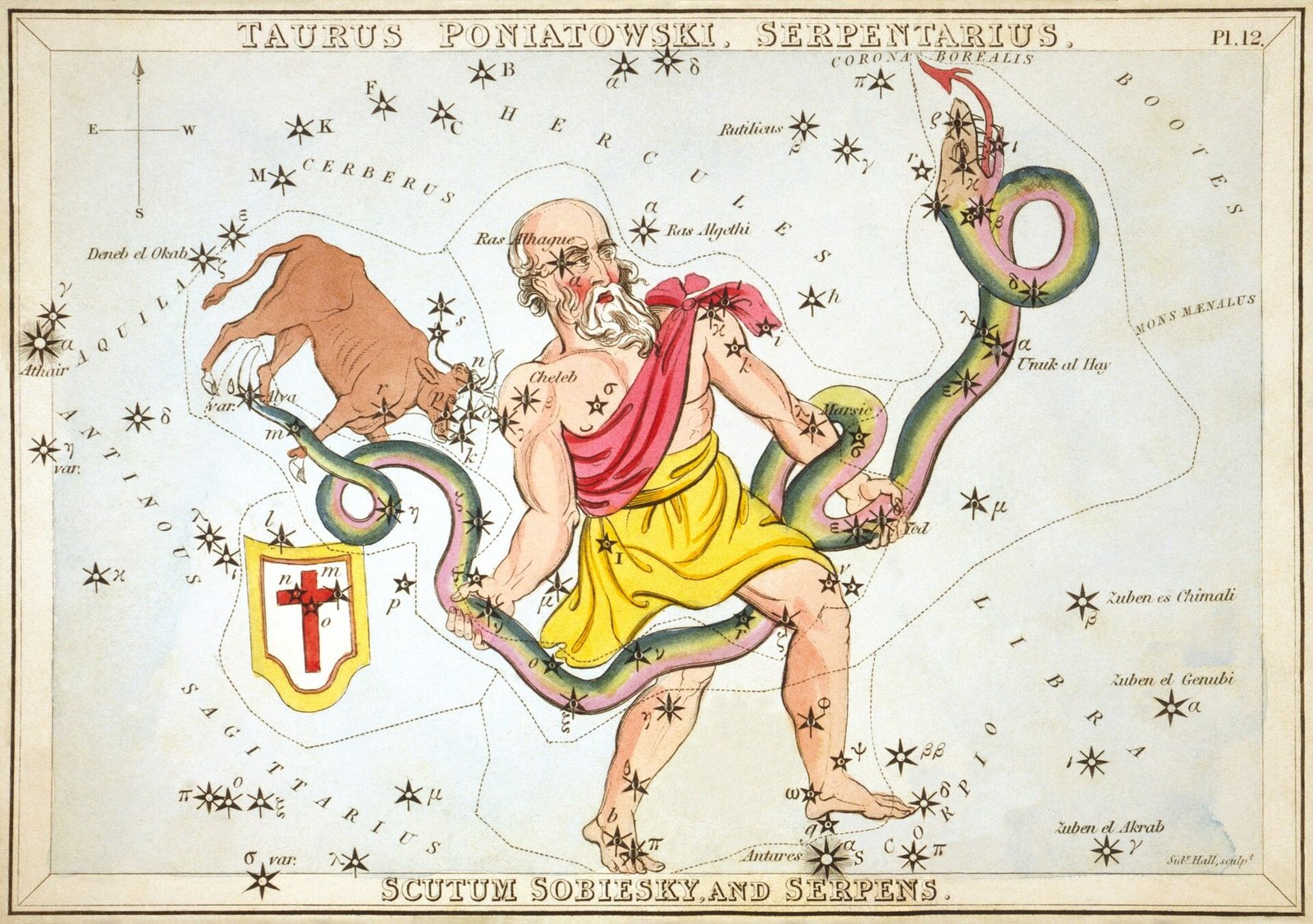
The Sun’s yearly path, the ecliptic, passes through thirteen constellations, not twelve. Between Scorpius and Sagittarius sits Ophiuchus, the serpent-bearer, and the Sun spends roughly two and a half weeks crossing it each year, around late November to mid-December. The constellation is real, the Sun really passes through it, and this has been known for millennia. No space agency discovered it recently.
The Babylonians who built the twelve-sign zodiac knew about Ophiuchus too. They chose twelve divisions deliberately: twelve fit the lunar calendar, with roughly twelve moon cycles per year, and twelve divides the 360-degree circle into neat 30-degree segments. The twelve signs were a measuring system, not a census of constellations.
Constellations are not signs
This is the misunderstanding at the heart of the claim. In astrology, signs and constellations are different things. Constellations are irregular groups of stars of wildly different sizes: Virgo sprawls across 44 degrees of sky while Scorpius covers about 7. Signs are twelve equal 30-degree divisions of the ecliptic used as a coordinate system.
Western astrology uses the tropical zodiac, which is anchored to the seasons rather than the stars. Zero degrees of Aries is defined as the spring equinox, full stop. Because of this, the tropical signs have drifted away from their namesake constellations over two thousand years of axial precession, and astrologers know it. Our explainer on tropical versus sidereal astrology covers how that drift works.

Why no thirteenth sign
Adding Ophiuchus as a sign would mean abandoning the twelve-fold system that the entire structure of astrology is built on: twelve houses, twelve divisions, the symmetry of oppositions and the geometry of aspects. A thirteen-sign wheel would not be a correction to astrology; it would be a different system that breaks the math everything else uses.
Sidereal astrology, which does track the actual constellations, also uses twelve signs. It simply applies the twelve-fold division to the star-based zodiac rather than the season-based one. Nobody in either tradition has a working thirteen-sign system in common use, because the twelve-fold division is load-bearing.
What about the “your sign changed” headlines
The headlines usually present a table of dates showing when the Sun is “actually” in each constellation, implying your sign should follow the constellations. But your tropical sign was never defined by which constellation the Sun sat in. It is defined by the Sun’s position in the seasonal zodiac. A Taurus born in early May is Taurus because the Sun was in the second 30-degree segment after the spring equinox, not because of where the stars of Taurus happened to be.
The related confusion about signs near boundaries has its own explanation. If you were born near a sign change and your sign feels off, the cause is almost always birth time, time zone, or the exact minute of the Sun’s ingress, not Ophiuchus. Our piece on planets near sign boundaries sorts out what actually happens at the edges.

The takeaway
Ophiuchus is a genuine constellation with a genuine place on the ecliptic, and it deserves its obscurity even less than it gets. But it is not a missing zodiac sign, and its existence changes nothing about anyone’s chart. The twelve-sign zodiac is a coordinate system, chosen for its symmetry two thousand years ago, and it works the way coordinate systems work: by convention, applied consistently. The next time the headline circulates, you will know exactly which part is true and which part is not.