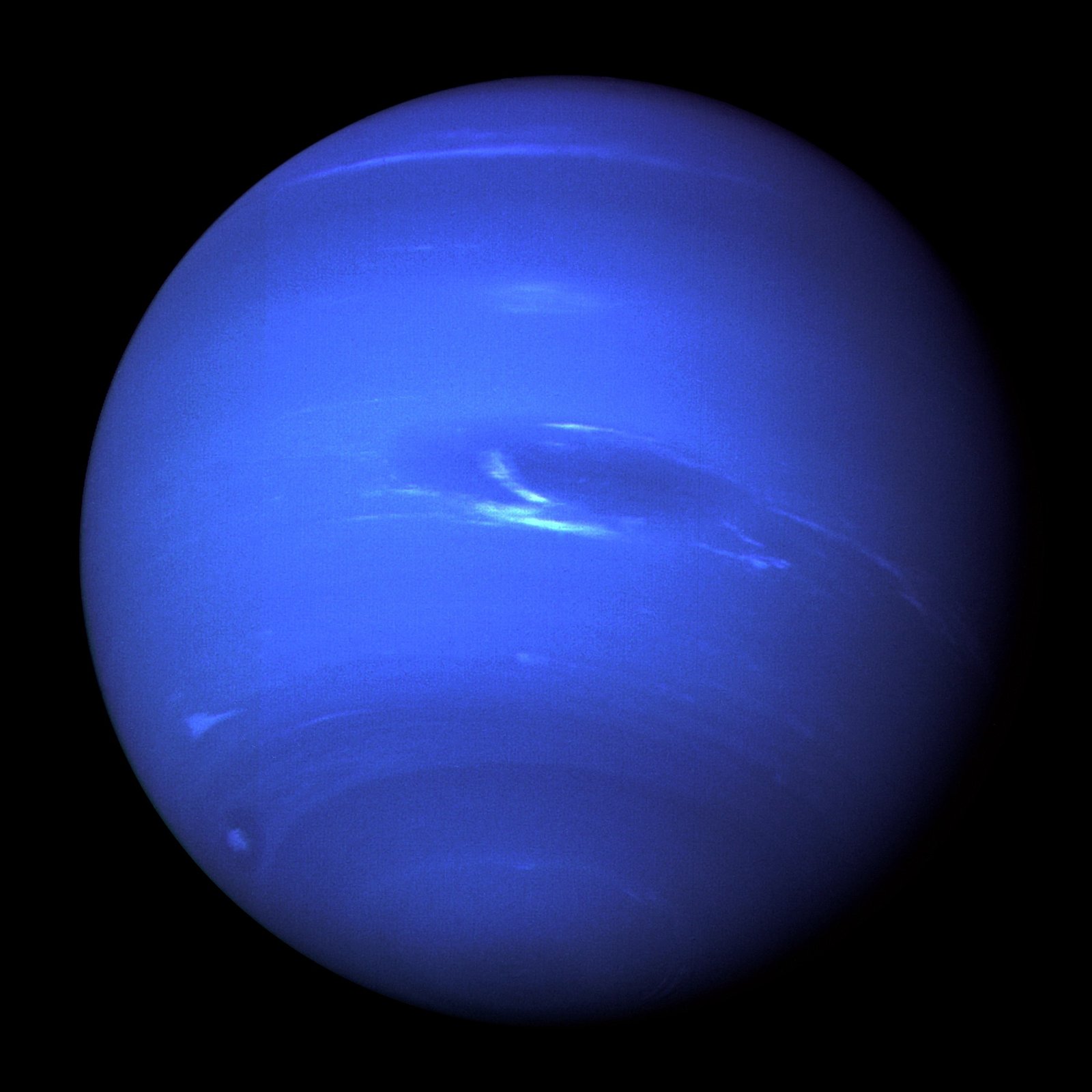
Neptune is the planet of dreams, and like dreams, it does not come with an instruction manual. In your birth chart it shows where you idealize, where you escape, where your imagination runs strongest, and where the boundary between you and everything else gets thin. It is the most beautiful placement in the chart and the hardest to read clearly, because fog does not photograph well.
The farthest planet, the deepest water
Neptune orbits at the edge of the planetary system, cold, blue, and windy, with the fastest winds in the solar system tearing through an atmosphere of hydrogen, helium, and methane. It is named for the Roman god of the sea, and astrology took the hint: Neptune rules the ocean, dreams, music, film, spirituality, and everything that dissolves boundaries. It was discovered in 1846 through mathematics before anyone saw it, predicted from wobbles in Uranus’s orbit, which suits a planet whose whole theme is the unseen made real.
Like Uranus and Pluto, Neptune spends about fourteen years in each sign, so your Neptune sign is generational. Neptune in Capricorn, roughly 1984 to 1998, dreams of structures; Neptune in Aquarius, roughly 1998 to 2012, dreams of networks. The personal reading lives in the house and the aspects, the same as with the other outer planets.
Neptune by house: where you dream
The house shows where idealism, imagination, and confusion concentrate. Neptune in the first house: a chameleon identity, deeply sensitive to atmosphere, often perceived as mysterious or hard to pin down. In the second: a foggy relationship with money, generosity that needs boundaries, or income through creative or healing work.
In the third: a dreamy, associative mind, vivid inner life, sometimes difficulty with linear detail. In the fourth: idealization of home or family, or a family history with missing pieces. In the fifth: romantic idealism, artistic talent, the risk of loving the fantasy more than the person. In the sixth: sensitivity to work environments, the need for meaningful daily work, health that responds to stress and rest.
In the seventh: idealizing partners, or attracting partners who need saving; the lesson is seeing people as they are. In the eighth: deep intuitive or psychic sensitivity, merged finances that need clarity. In the ninth: the spiritual seeker, devotion to a philosophy or teacher, discernment as a practice. In the tenth: a public image with a glamorous or elusive quality, careers in art, film, music, or healing. In the eleventh: idealistic friendships and causes, or disillusionment with groups. In the twelfth: the mystic’s placement, thin boundaries with the collective unconscious, dreams that feel like messages.
Read the house as the fog zone: the area where you most need to check whether you are seeing clearly. Our guide to planet vs sign vs house explains how the house personalizes slow-moving planets.
The gifts are real
It is easy to write Neptune as only confusion, and that misses half the planet. Neptune gives imagination, compassion, artistic sensitivity, and spiritual depth. The same placement that idealizes a partner can write the song that makes a room cry. The same fog that confuses a budget can dissolve the boundary between self and other in meditation. Neptune’s gifts and its problems are the same capacity: permeability. The question is never whether you are permeable. It is what you let through.
Working with the fog
Neptune does not respond to force. You cannot argue your way out of a Neptunian fog or schedule your way out of Neptunian confusion. What works is practices with built-in clarity: writing things down, checking perceptions against evidence, keeping one foot in a routine while the other explores. Artists with strong Neptune placements often develop rigorous craft precisely to give the fog a channel. The discipline is the riverbank; the imagination is the river.
Aspects to Venus or the Moon intensify the whole picture: more romance, more art, more sensitivity, more need for discernment. Our walkthrough of how to read Venus by sign and house is a good companion when Neptune touches Venus, because the two planets share the territory of love and beauty, one with open eyes and one with closed ones. The goal is not to choose between them. It is to let each do what it does best: Venus to love the real, Neptune to imagine what the real could become.