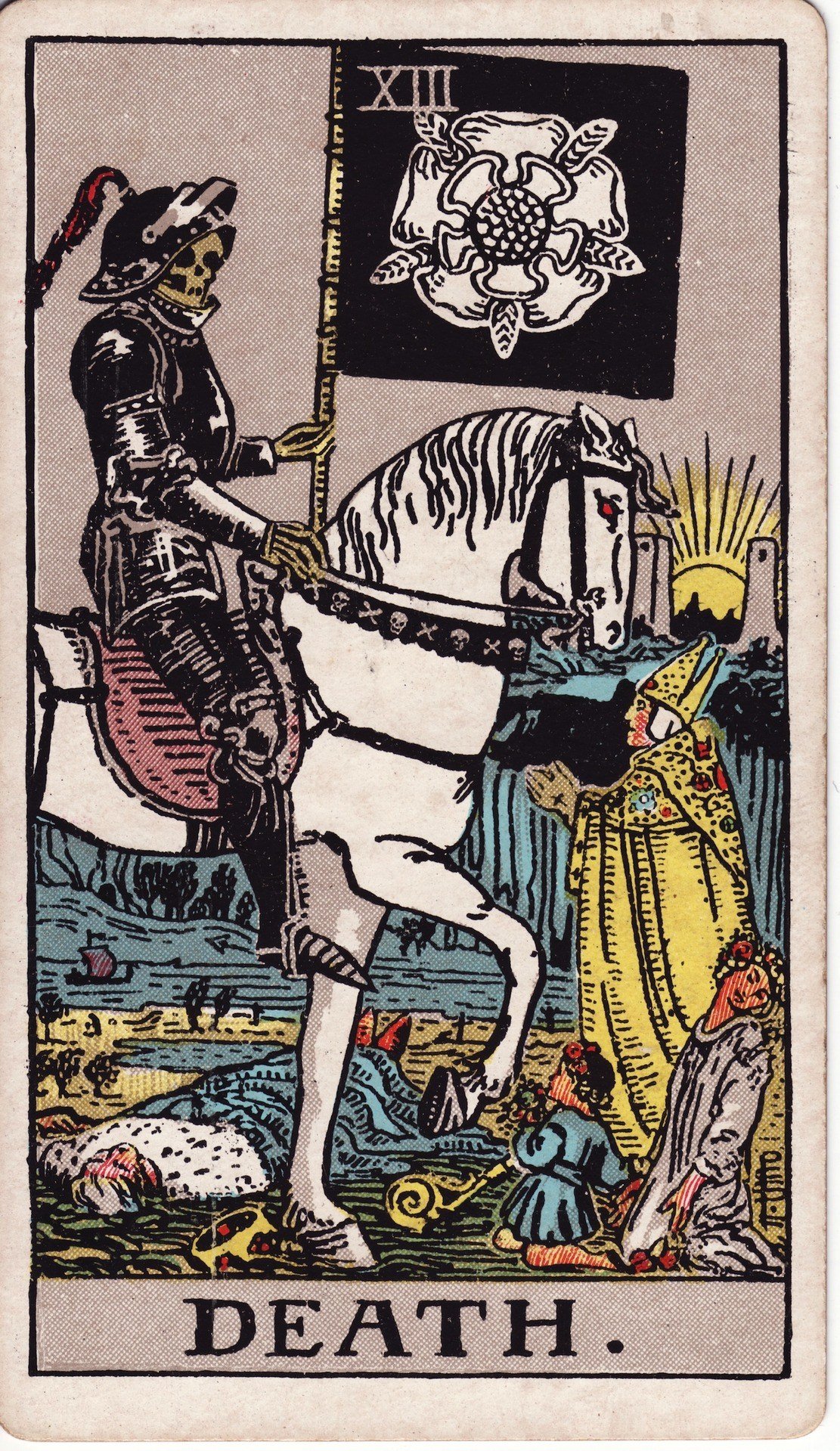
Let us get the fear out of the way first: the Death card is not predicting anyone’s death. In hundreds of years of tarot tradition, it has never meant literal death in a reading, and any reader who tells you otherwise is either inexperienced or trying to frighten you. The card means endings. Specifically, it means the kind of ending that makes room: a chapter closing so thoroughly that something new can actually begin.
What the image is really saying
The Rider-Waite-Smith Death rides a white horse, the traditional color of a victorious conqueror, carrying a black banner marked with a white rose. The rose is the important detail. In the tradition it stands for purity and new life, and it echoes the white rose on the Fool’s tunic at the start of the journey: what ends here connects to what began there. A king lies fallen in the foreground, because Death does not respect rank. A child looks up without fear, because children have not yet learned to dread change. In the distance, the sun rises between two towers.
The card’s astrological correspondence is Scorpio, the sign of transformation, and its ruling planet in the tradition is Pluto. Both point to the same theme: the composting of experience. Nothing is wasted. Everything finished becomes material for what comes next.

Endings that make room
The Death card appears when something is over and staying over. The relationship that ended months ago but still occupies your evenings. The job you mentally quit a year before you actually leave. The identity, hometown version of you, old grievance, that you have outgrown but keep carrying out of habit. The card is not announcing these endings. It is confirming them, and asking what you plan to do with the freed space.
This is why Death is, paradoxically, one of the more hopeful cards. The Ten of Swords is rock bottom; Death is the decision to stop living in the rubble. Clients rarely dread this card once they understand it, because most people already know what needs to end. The card just says it out loud.
Death in different questions
In love readings, Death usually marks a relationship’s transformation rather than its funeral. Sometimes that is an ending, honestly named. Sometimes it is a phase dying: the early romance giving way to something steadier, or a dynamic that stopped working being replaced by a better one. The card asks whether you are mourning the relationship or mourning your idea of it. Those are different griefs.
In career readings, Death is the closed door that turns out to be a corridor. The layoff, the failed venture, the career change at forty. The card’s counsel is to grieve quickly and completely, then look at the empty calendar as raw material. In spiritual questions, Death marks the shedding of a belief or practice that served its purpose. You do not owe your old worldview a lifetime appointment.

How to work with it
When Death appears, the useful questions are practical ones. What is already over that I am still feeding? What would I start if I admitted the ending? What am I afraid the ending says about me? That last question matters most, because resistance to Death is almost always about identity: if I am not the person in that relationship, that job, that city, who am I? The card’s answer is that you get to find out, and that the finding out is the point.
Our guide to asking better tarot questions is useful here, because “will this end?” wastes the card’s energy. Better: “what is ending, and what wants to begin?” The card rewards the querent who asks about the room, not the door.
The Death card sits at the center of the Fool’s journey through the major arcana, the hinge between the outer experiences of the first half and the inner work of the second. Everything after it, Temperance through the World, is built on ground that Death cleared. Endings are not the opposite of beginnings in this deck. They are the entrance fee.