
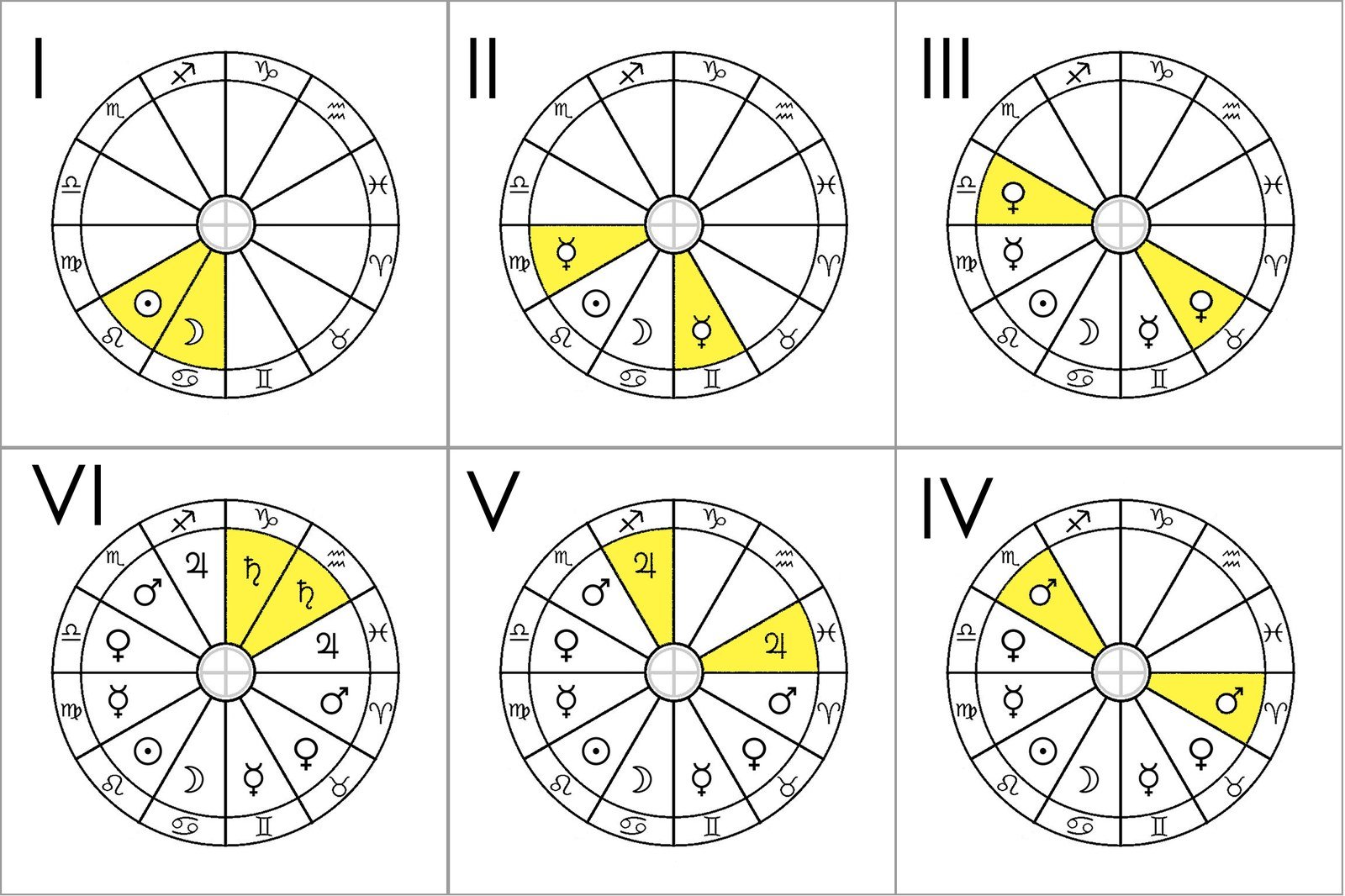
Traditional astrology gives every planet a report card for every sign. Some signs are a planet’s home, where it acts with confidence and ease. Others are the opposite: strange territory where the same planet stumbles, overcompensates, or goes quiet. This grading system is called essential dignity, and it is one of the oldest tools in the craft, reaching back to Hellenistic astrologers and Ptolemy’s Tetrabiblos. It does not say a planet is good or bad. It says whether the planet is resourced or struggling, and that distinction changes how you read any chart.
Domicile and detriment: at home or out of place
Domicile is the simplest dignity: each planet rules one or two signs, and in those signs it is at home. Mars rules Aries and Scorpio. Venus rules Taurus and Libra. Mercury rules Gemini and Virgo. The Moon rules Cancer, the Sun rules Leo, Jupiter rules Sagittarius and Pisces, and Saturn rules Capricorn and Aquarius. A planet in domicile behaves like a host in its own house: direct, comfortable, sure of where everything is. Detriment is the mirror image. A planet in the sign opposite its domicile is a guest in hostile territory. Mars in Libra (opposite Aries) still wants to act, but Libra’s rules say act only after everyone agrees, so the action stalls or comes out passive-aggressive. Venus in Scorpio (opposite Taurus) wants simple affection and gets intensity instead. Detriment is not a curse. It is friction, and friction can be worked with once you name it.
Exaltation and fall: the honored guest and the ignored one
If domicile is being home, exaltation is being the guest of honor. The scheme says each planet has one sign where it is celebrated and given the best seat: the Sun is exalted in Aries, the Moon in Taurus, Mercury in Virgo, Venus in Pisces, Mars in Capricorn, Jupiter in Cancer, and Saturn in Libra. An exalted planet performs at its peak, often with a touch of showmanship. Mars in Capricorn acts with strategy and stamina; Venus in Pisces loves boundlessly. The fall is the opposite seat: the sign where the planet is present but nobody listens. The Sun falls in Libra, the Moon in Scorpio, Mercury in Pisces, Venus in Virgo, Mars in Cancer, Jupiter in Capricorn, Saturn in Aries. A planet in fall often expresses itself in a muted or distorted way, like a talented speaker handed a broken microphone.

What dignity means in practice
Here is the part that actually matters for reading charts. Dignity describes condition, not character. A dignified Mars does not make a good person; it makes a planet that can do Mars things (decide, push, compete, protect) without tripping over itself. A debilitated Mars, in detriment or fall, does the same things with static on the line: hesitation, misdirected force, or blowups after long silences. Think of it as the difference between a chef in a stocked kitchen and the same chef in a kitchen with half the tools missing. Same chef, same skills, very different dinner. This is why two people with Mars in prominent positions can behave so differently: check the sign before you judge the planet. Our guide to reading Mars by sign and house puts this idea to work with concrete examples.
A worked example: Venus in Pisces vs. Venus in Virgo
Take Venus, the planet of affection, taste, and what we find pleasing. In Pisces, Venus is exalted: this is love as devotion, wide open and forgiving, the person who falls completely and means it. The same Venus in Virgo is in fall: love becomes a quality-control department, scanning the beloved for flaws and expressing care through criticism and helpful fixes. Neither placement is better as a human being. The Pisces Venus can drown in fantasy and ignore red flags; the Virgo Venus can starve a relationship of warmth while trying to perfect it. Dignity tells you where the planet’s expression flows and where it snags. For the parallel walkthrough with the other relationship planet, see reading Venus by sign and house.
Dignity is one layer, not the whole chart
A common beginner mistake is treating dignity as a verdict: dignified equals blessed, debilitated equals doomed. Traditional astrologers never used it that way. Dignity is one input among several. A planet in fall but well-supported by aspects and a strong house can do fine work; a planet in domicile that is afflicted by hard aspects can still cause trouble, just trouble delivered with confidence. The dignity scheme also sits inside the larger grammar of planets, signs, and houses, where the planet is the actor, the sign is the costume, and the house is the stage. Dignity tells you how well the costume fits. Start there, then read the rest of the sentence.
Featured image: photo by Дмитрий Кошелев (CC BY-SA 4.0), via Wikimedia Commons.