
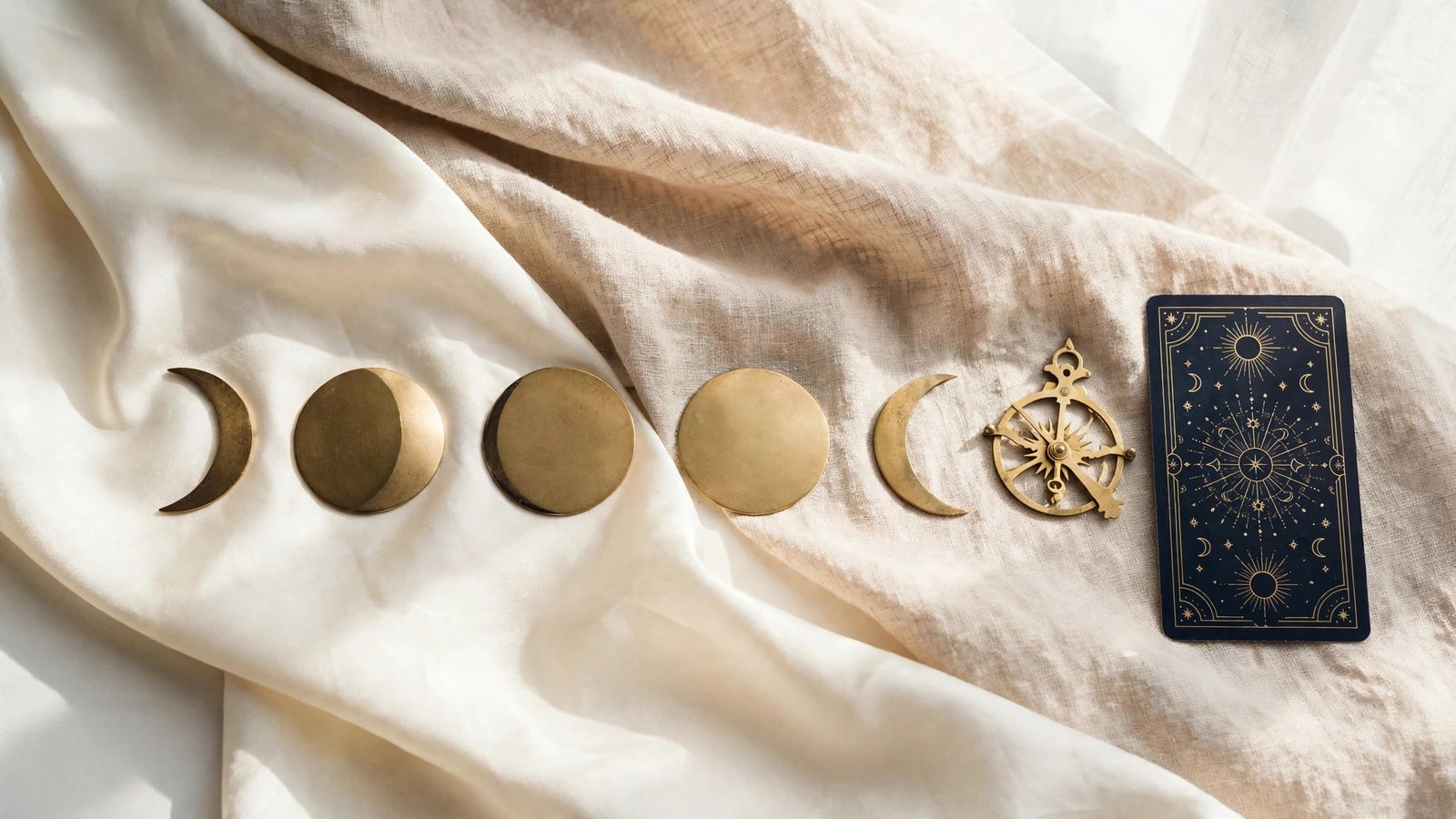
The Moon is the fastest major body in astrology, sweeping through all twelve zodiac signs in about 27 days. That means the moon sign changes roughly every two to two-and-a-half days — faster than any planet, and fast enough that the emotional “weather” it symbolizes genuinely shifts several times a week. If you’ve ever wondered why Monday felt tender and Wednesday felt electric for no obvious reason, the moving Moon is one symbolic lens worth checking.
The Simple Astronomy Behind It
The Moon orbits Earth in about 27.3 days (a sidereal month). Divide the 360-degree zodiac by 12 signs of 30 degrees each, and the math is straightforward: the Moon spends an average of 2.28 days per sign. Some sign ingresses come a little faster or slower depending on the Moon’s variable speed, but “every two to three days” is a reliable rule of thumb.
Compare that to the other planets: Mercury spends weeks in a sign, Venus over a month, Mars about two months, Jupiter a year, Saturn two and a half years. The Moon laps them all. It’s the only astrological body fast enough to function as a daily timing symbol — which is exactly why lunar awareness is the backbone of most daily astrology practices.
What the Changing Sign Symbolizes
In astrological tradition, the Moon represents the inner life: feelings, instincts, comfort needs, memory, and the body’s quiet signals. As it moves through the signs, the flavor of that inner life shifts:
- Fire signs (Aries, Leo, Sagittarius): days that may feel more expressive, restless, or hungry for experience.
- Earth signs (Taurus, Virgo, Capricorn): days that may invite grounding, routine, and attention to the physical and practical.
- Air signs (Gemini, Libra, Aquarius): days that may favor conversation, ideas, and social connection.
- Water signs (Cancer, Scorpio, Pisces): days that may feel more introspective, tender, or emotionally vivid.
These are collective themes — the background music everyone faintly hears. Your personal experience of a moon sign also depends on your natal chart: the Moon passing through your natal fourth house will feel different from passing through your tenth, and its aspects to your natal planets add personal texture to the generic sign theme.
Why It Changes How a Day Feels
There’s nothing mystical about noticing this. Human attention is rhythmic — energy, sociability, and introspection genuinely ebb and flow across days. The moon-sign cycle gives those natural fluctuations a name and a narrative, which makes them easier to work with. “Oh — Moon in Virgo, that’s why I’m suddenly reorganizing the kitchen” is a small moment of self-understanding, and small moments compound.
The practical value is mostly about matching: aligning the day’s demands with the day’s symbolic weather when you can. A Moon-in-Gemini day might be a natural fit for calls and writing; a Moon-in-Taurus day for slow, sensory pleasures; a Moon-in-Scorpio day for the deep conversation you’ve been postponing. You’re not obeying the Moon — you’re surfing a rhythm.
Tracking It Without Obsessing
The two-day rhythm is quick enough to be useful and quick enough to become noise if you over-monitor it. A sustainable approach:
- Check once in the morning. Thirty seconds: what sign is the Moon in today? One sentence of reflection is plenty.
- Note the ingress days. The day the Moon changes sign often feels like a subtle gear-shift. Noticing the shift teaches you more than memorizing sign meanings.
- Watch your natal Moon’s sign especially. When the transiting Moon returns to your natal moon sign (every ~27 days), many people report feeling unusually “themselves” — more emotionally legible, for better or worse.
- Don’t plan your life around it. The moon sign is background music, not a schedule. If a “wrong-sign” day brings something wonderful, that’s not a failure of astrology — it’s a reminder that symbols describe tendencies, not rules.
The Moon Sign and Your Natal Chart
One more layer for the curious: the transiting Moon forms aspects to your natal planets as it circles, roughly once a month per planet. The monthly Moon–Moon conjunction (your lunar return) is the most personal of these — a mini emotional reset worth marking. Conjunctions to natal Venus or Mars can tint a day relationally; to natal Mercury, mentally. You don’t need to track all of these — but knowing the mechanism exists helps you understand why some moon-sign days hit you harder than others.
Frequently Asked Questions
How do I find the current moon sign?
The simplest way is a dedicated page that shows it at a glance — no calculation needed. Many astrology apps and websites display “Moon in [sign]” on their daily pages. If you want to understand the mechanics, an ephemeris (a table of planetary positions) lists the Moon’s sign for every day of the year. But for daily practice, a quick check beats manual calculation every time; the goal is reflection, not astronomy homework.
Is there scientific evidence that the moon sign affects mood?
The honest answer: very little. Studies on lunar effects (sleep, mood, behavior) have produced mostly null or weak results, and none of them test moon signs specifically — that’s a symbolic framework, not a physical hypothesis. This doesn’t make the practice worthless; it makes it reflective rather than causal. The moon sign works the way a good metaphor works: not by exerting force, but by giving your attention a useful shape. Hold it that way and there’s no conflict with science.
What happens in the moment the Moon changes signs?
The ingress itself is brief — a boundary crossing, not an event. But the hours around it often carry a subtle gear-shift feeling, especially if the two signs are very different (say, from intense Scorpio to expansive Sagittarius). Traditional astrology also notes the void-of-course period that often precedes ingress — the Moon’s “pause” between its last aspect and the sign change. Noticing ingress days trains the same muscle as noticing the sign itself: attention to rhythm.
Check today’s emotional weather: Moon Sign Today shows the Moon’s current sign with its reflective themes — a ten-second check that adds a little texture to your morning.