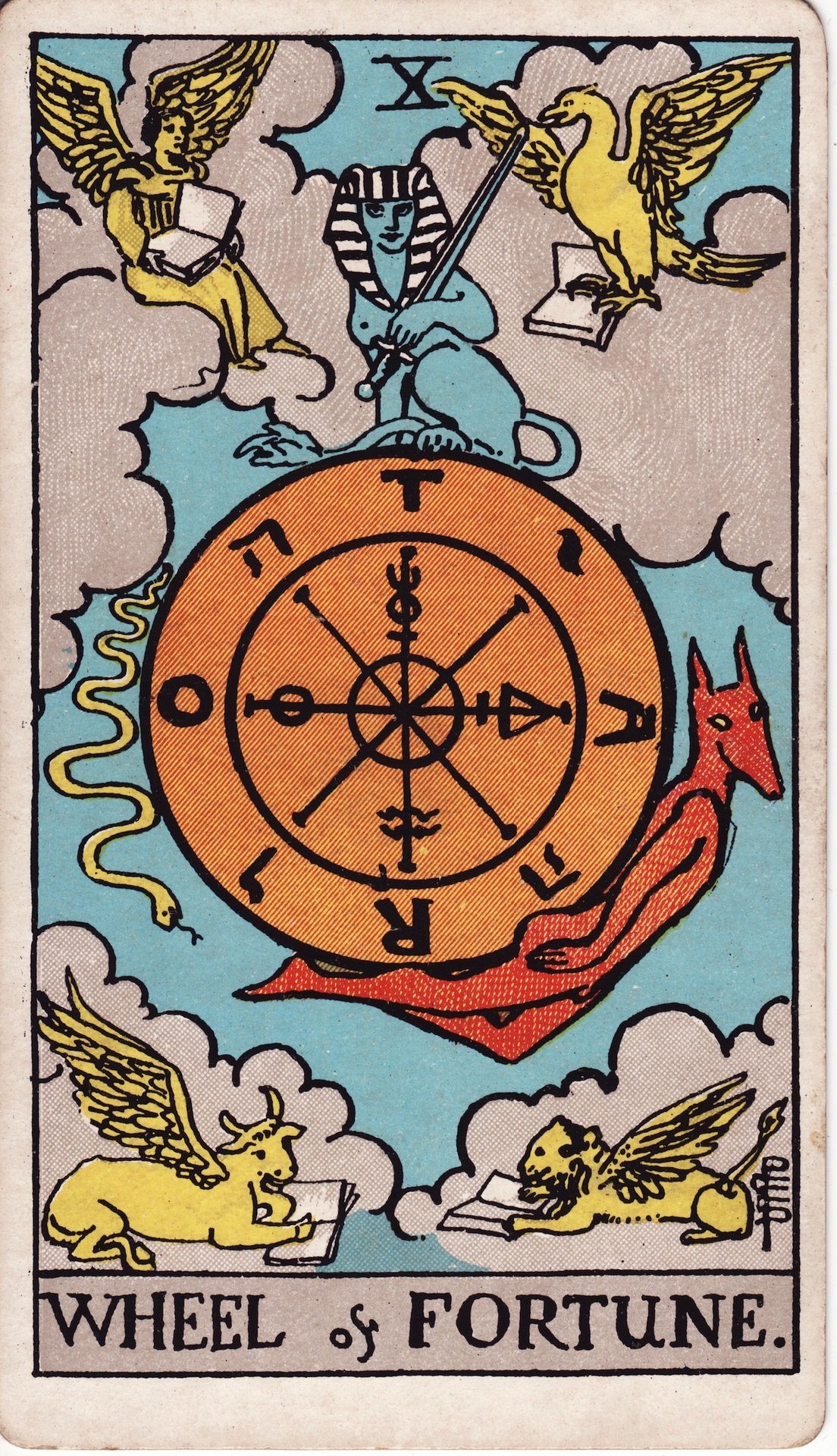
The Wheel of Fortune is the card of cycles, and it arrives with a perspective most readings lack: the long view. Where other cards describe what is happening, the Wheel describes where this moment sits in the turning. Up or down, the wheel keeps moving. The card’s message is not that your luck is changing. It is that change is the only permanent condition, and your current position on the wheel is temporary by definition.
What the wheel shows
The Rider-Waite-Smith Wheel is crowded with symbolism: the rotating wheel itself, inscribed with the letters T-A-R-O and alchemical symbols; four winged figures in the corners representing the fixed signs of the zodiac; a sphinx perched on top holding a sword; a snake descending on one side and a dog-headed figure ascending on the other. The traditional reading: the wheel turns, the sphinx knows, and the creatures ride up and down whether they understand the mechanism or not.
The card corresponds to Jupiter, the planet of expansion, luck, and the bigger picture. That correspondence matters because it corrects the common misreading. The Wheel is not random fortune, good or bad. It is Jupiterian: cycles of growth, the widening of perspective, the sense that events are part of a larger pattern even when the pattern is not yet visible.

Reading the cycles
The practical skill the Wheel teaches is locating yourself in a cycle. Every situation has a phase: the rise, the peak, the decline, the trough, and the turn. Most bad decisions come from misreading the phase. Investing heavily at the peak, despairing in the trough as if it were permanent, mistaking the turn for the trend. The Wheel asks a single diagnostic question: where on the wheel is this?
In career readings, the Wheel often marks a turning point: the promotion cycle, the industry shift, the moment a long effort starts paying off or a good run starts cooling. In relationships, it describes phases rather than verdicts: the honeymoon, the hard year, the renewal. The card rarely says stay or go. It says notice the season, because seasons change and strategies should change with them.
The number ten
The Wheel is card X, ten, the number of completion and return. Ten reduces to one, the end that is also a beginning, which is exactly how cycles work. In tarot numerology, tens mark the full expression of their suit or, for major arcana, the turning of a larger pattern. Our guide to tarot numerology covers how the tens function as both endings and seeds, and the Wheel is the purest expression of that double meaning.
This is also why the Wheel pairs so naturally with the Death card in readings. Death ends the chapter; the Wheel turns the page. One closes, the other continues. Together they describe the complete rhythm of change: the ending you choose or accept, and the larger cycle that was moving underneath it all along.

When the wheel turns down
The Wheel’s honesty includes the downward turn. Fortunes reverse, good runs end, and the card does not pretend otherwise. What it offers instead of comfort is proportion. The trough is not the whole story; it is the trough’s turn. People who have lived through several turns recognize the feeling: this has happened before, it will happen again, and the appropriate response is steadiness rather than panic or euphoria.
The card’s counsel at the top of the wheel is humility: enjoy it, share it, do not mistake the peak for your permanent address. At the bottom, the counsel is patience with an edge of preparation: the wheel is already moving, so use the trough for the work that peaks do not allow. Reflection, repair, learning. The bottom of the wheel is the best classroom in the deck.
The long view as a practice
Our guide to the major arcana and the Fool’s journey places the Wheel at the center of the sequence, the hinge between the personal cards and the cosmic ones. That placement is the teaching: the personal story matters, and it is also one turn of something larger.
When the Wheel appears, try the long-view exercise. Describe the situation as a chapter title in a much longer book. Name the previous chapter and guess the next. The exercise does not change the facts, but it changes their size, and size is often the real problem. The wheel keeps turning whether you watch it or not. The card just invites you to watch, and to remember that every position on a wheel is, by geometry, temporary.