
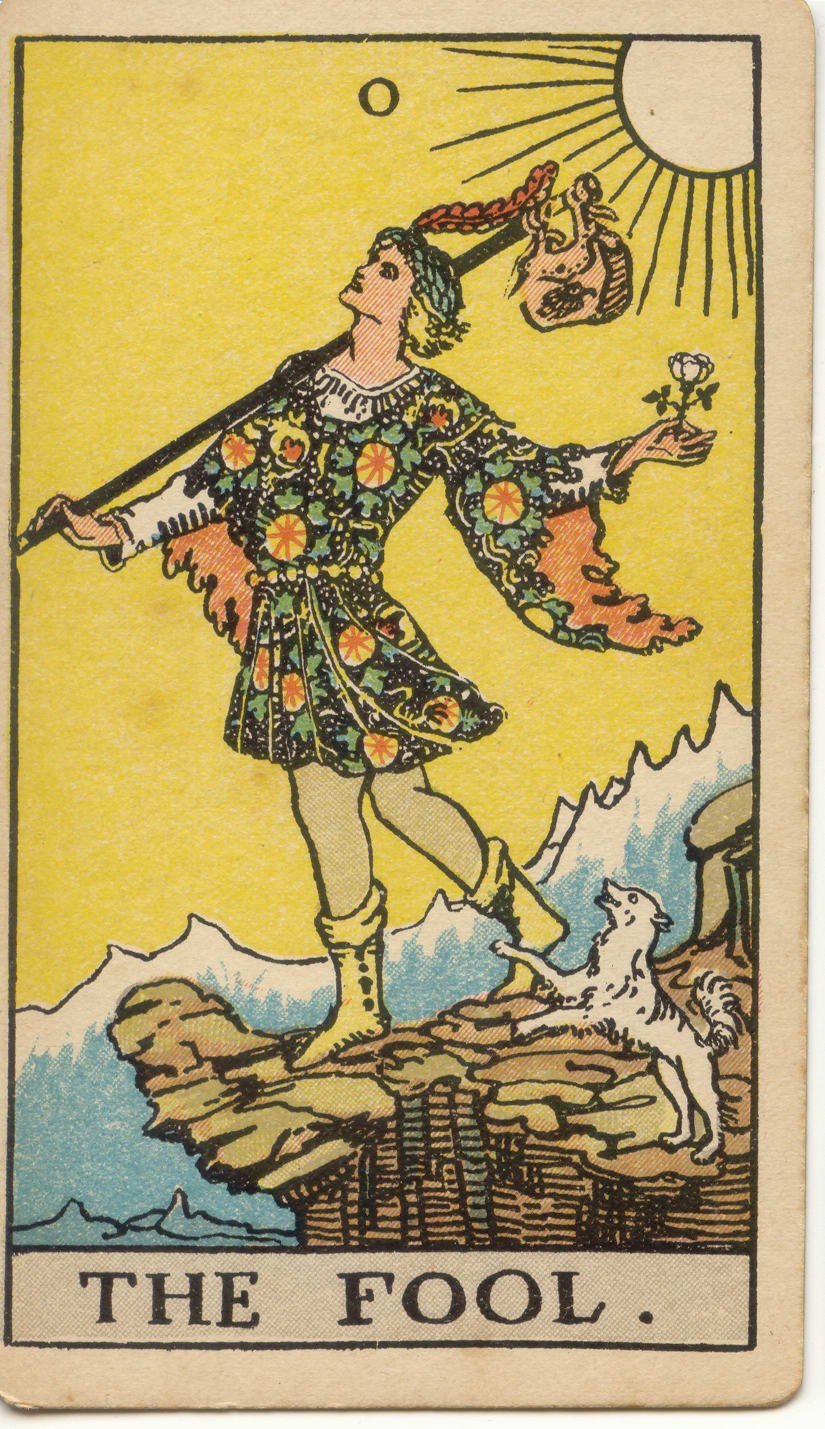
The Fool is card zero. That number puts it at the very start of the major arcana, ahead of the Magician and everything after, and it colors every reading the card appears in: this is the card of the step you have not taken yet. A young traveler walks toward the edge of a cliff, eyes lifted to the sky, a small white dog at their heels and a bindle slung over one shoulder on a staff. The scene has looked much the same since the earliest decks: a person at the boundary of the known world, about to move past it.
In the Rider-Waite-Smith deck the image is bright and almost cheerful. The Fool wears a wreath of leaves, the sun shines overhead, and the little dog barks at their leg, whether in warning or in play no one can say. Nothing in the picture suggests ruin. That matters, because many beginners read the card’s name before they read its picture, and they land on the wrong meaning entirely.
The cliff edge, in detail
Each element of the classic image works as a separate note in a reading. The cliff is the unknown itself: the point where the map ends. The bundle on the staff holds everything the Fool carries, which is deliberately little. Travel light. The small dog is instinct, the part of us that barks at the ankles of our own plans. In Pamela Colman Smith’s version the Fool also carries a white rose, a mark of clean intention, and snow-capped mountains rise in the distance, suggesting that the path beyond the cliff is longer than it looks from this side.
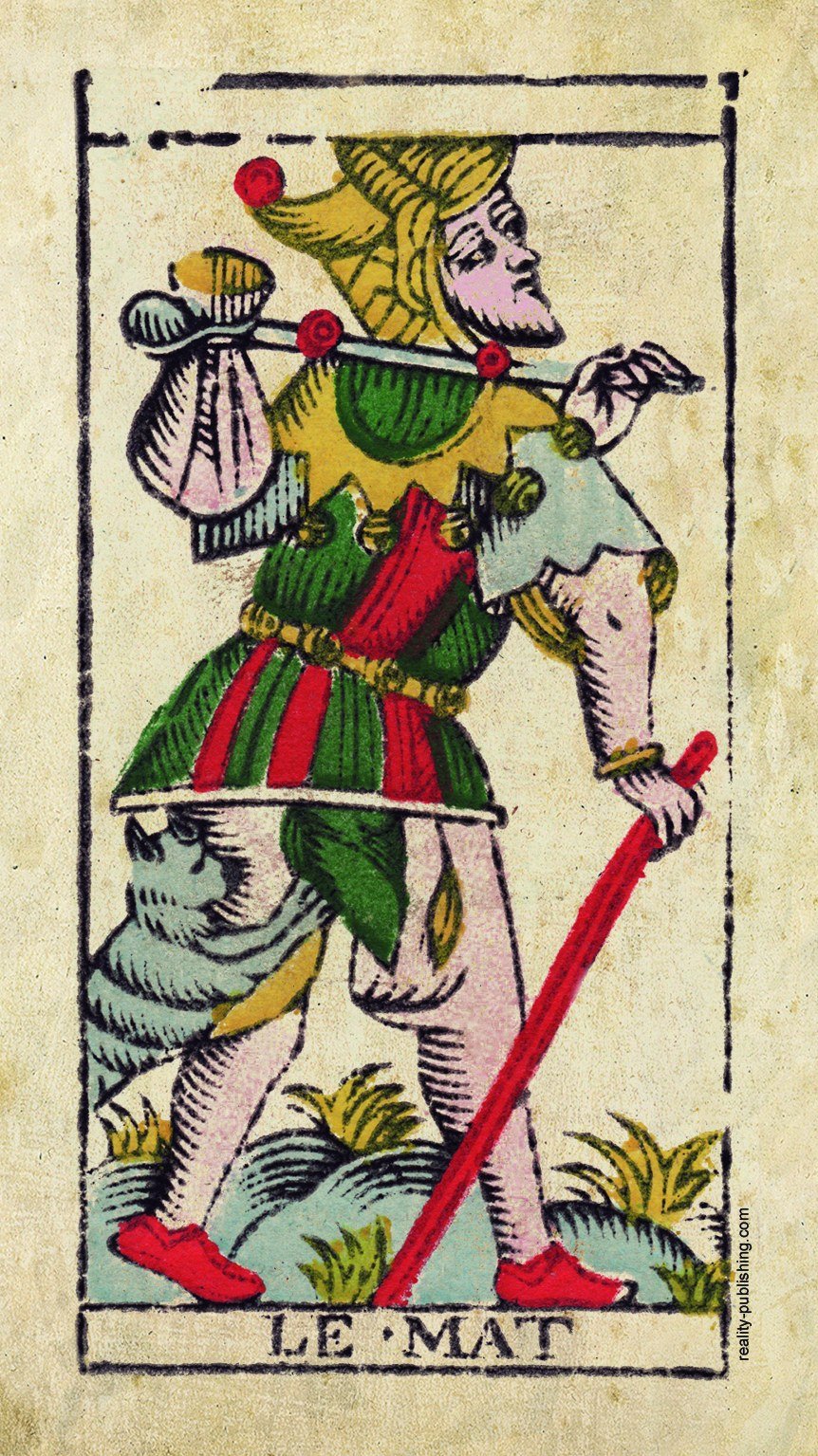
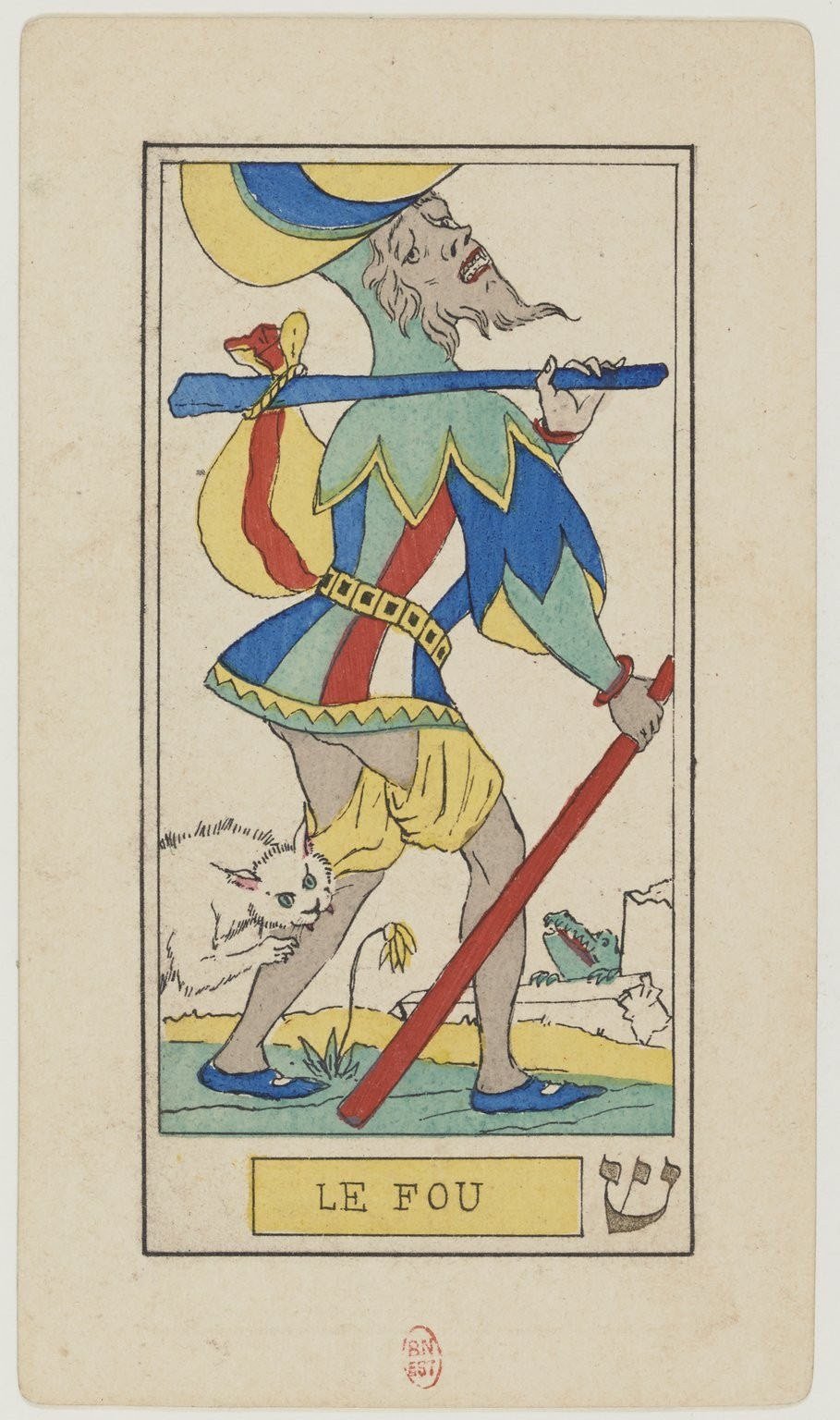
Older decks tell the same story in rougher form. In the Marseille tradition the figure is Le Mat, a ragged vagabond whose clothes are torn and whose dog is tearing at his trousers, not out of malice but out of the nature of dogs. The message survives every redrawing: the start of something looks undignified from the outside. If you want a fuller tour of the sequence this card opens, see the major arcana and the Fool’s journey.
Why the zero matters
Zero is not a rank. It places the Fool outside the numbered order: not yet committed, not yet shaped, carrying potential but no fixed direction. Every figure the Fool will meet further along the major arcana starts from this uncommitted state. That is why the card belongs to beginnings of every kind, from the concrete, like a move or a new job, to the internal, like deciding to trust someone after a long guarded stretch.
The Aces of the minor arcana carry a similar starting energy, one per suit. If you are learning how fresh-start cards differ across the deck, the Aces in tarot make a useful comparison.
Upright: the leap itself
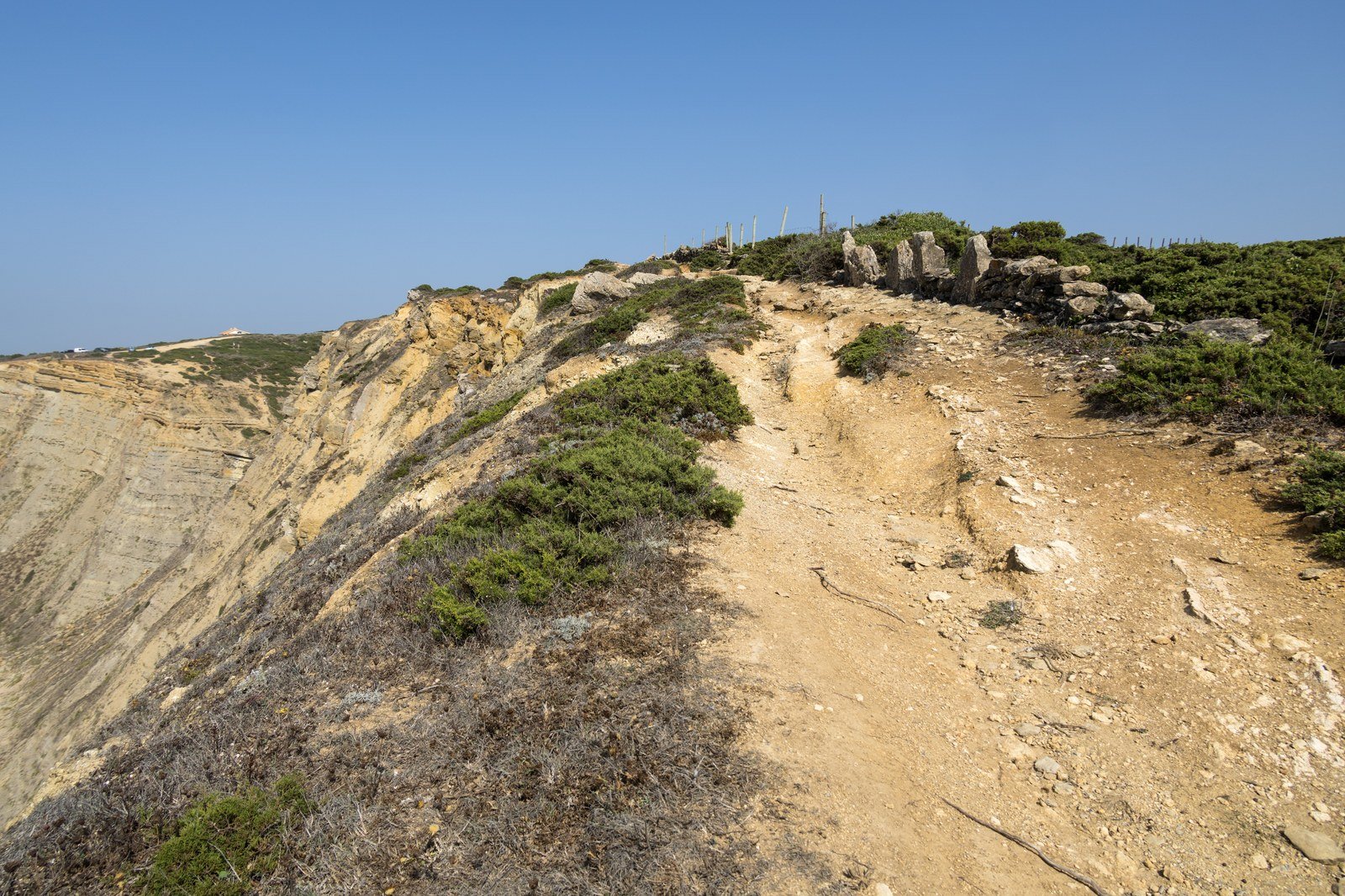
Upright, the Fool points to acting before you have the full picture. Spontaneity. A willingness to look unready. The readings it shows up in are the ones where the questioner already knows what they want to do and is asking permission they do not need. Take the trip. Send the application. Say yes to the thing that has no safety net attached, or at least a smaller net than you would prefer.
None of this means the card recommends recklessness. The Fool’s trust is aimed at the process, not at ignoring evidence. The leap is real and so is the cliff. A grounded way to work with the card in a daily pull is described in this beginner’s step-by-step guide to reading tarot, which treats every card as the start of a question rather than a final answer.
Reversed: the stalled start
Turned upside down, the card rarely means “you are foolish.” It usually describes one of two situations. The first is genuine carelessness: rushing the leap without looking, signing before reading, trusting the wrong guide. The second is the opposite: a start that will not launch. The traveler stands at the cliff edge and will not move, rehearsing the jump for months. Both are versions of the same failure, which is the failure to meet the moment at its own scale.
Reversals change the temperature of a card rather than flipping it into its opposite. If the mechanics of reversed cards are new to you, what changes when a card is reversed covers the practical difference.
The misread to avoid
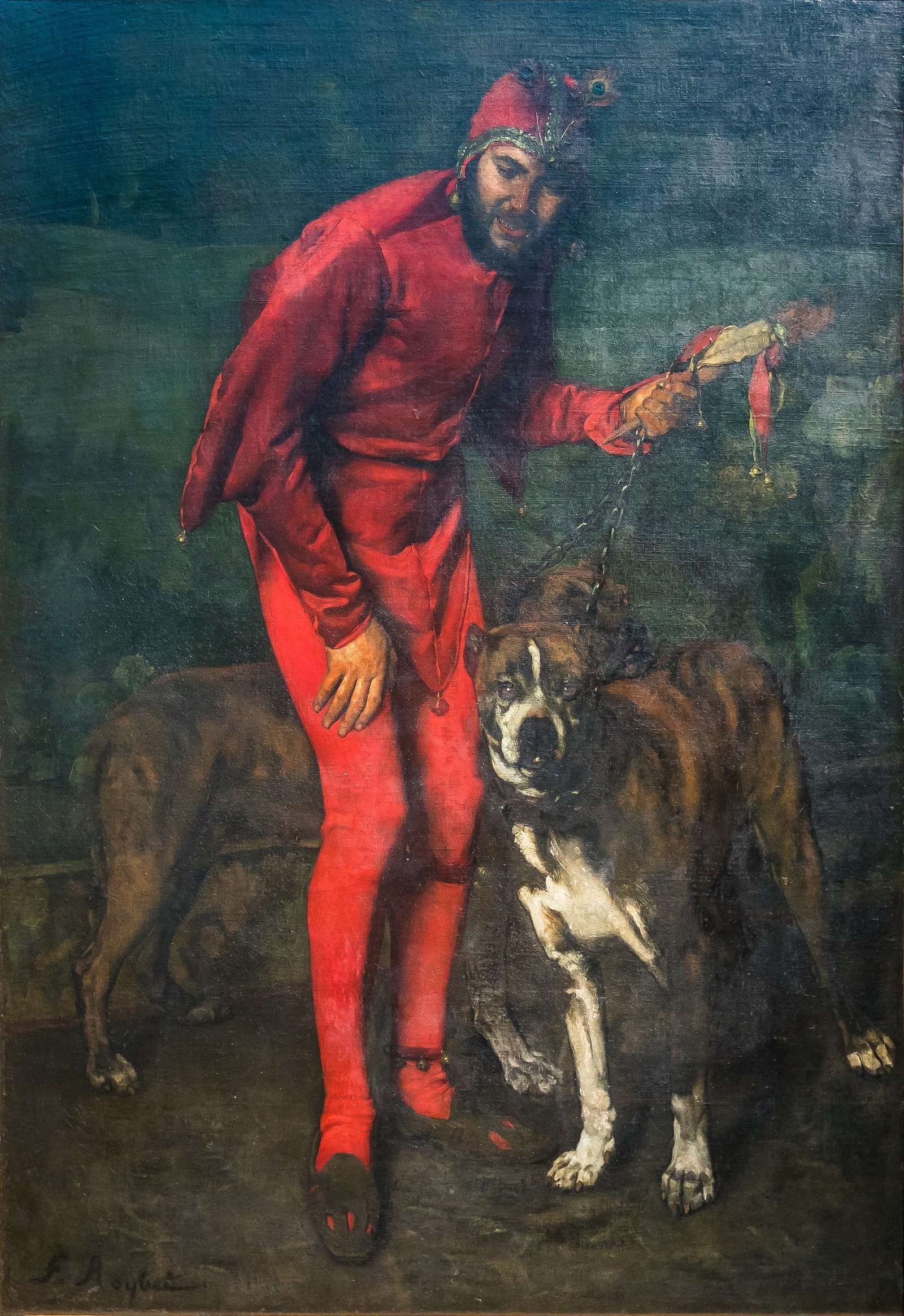
The most common misread of this card is taking the name at face value. The Fool is not the village idiot, and the card mocks no one. Medieval courts kept fools precisely because the fool could say what no one else was allowed to say. There is a long tradition of the fool as the one person in the room who is not pretending. When this card appears, it is usually pointing at honesty of that kind: the honest admission that you want the thing, that you are afraid of the thing, that you are going anyway.
Read this way, the Fool becomes one of the kindest cards in the deck. It does not promise a soft landing. It promises that the unlived version of your life is the one to fear, not the cliff.