
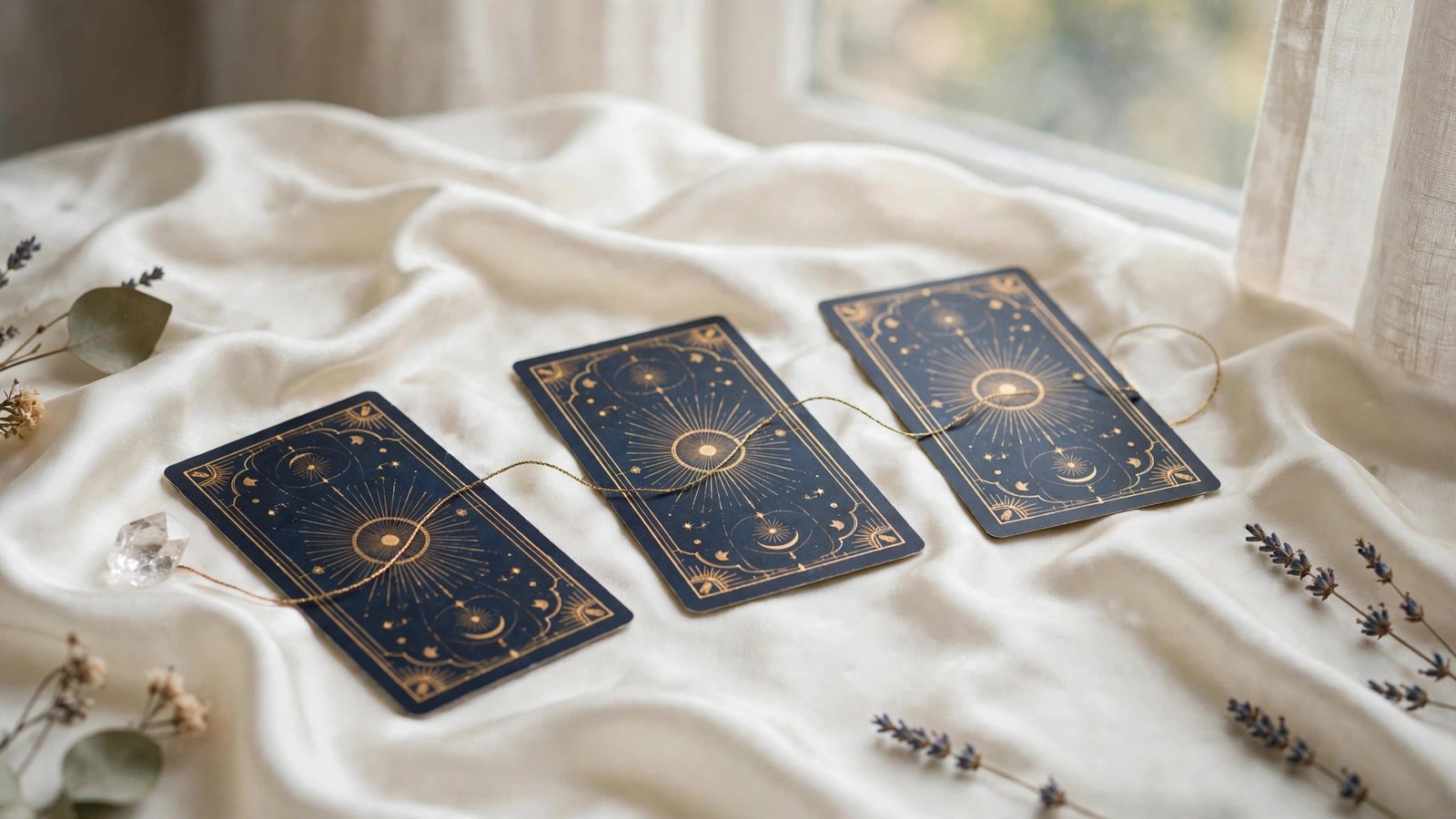
Reading one tarot card is like hearing one word. Reading several together is a conversation — and most beginners read spreads like a vocabulary list, defining each card in isolation and then staring at the pile, unsure how they connect. Learning how to read tarot card combinations is what turns memorized meanings into actual readings.
The Core Skill: Cards Modify Each Other
Cards in a spread are never truly separate. Each card colors the cards around it, like instruments in a band. The Tower next to the Star tells a different story than the Tower next to the Ten of Swords: one suggests disruption leading toward hope and renewal; the other suggests a collapse at the end of a long painful stretch. Same Tower, different conversation.
The reader’s job is to find the sentence the cards are forming together — not three separate definitions stapled side by side.
Five Techniques for Reading Cards Together
1. Find the Dominant Energy
Scan the spread for what’s loudest: a Major Arcana card, repeated numbers, a dominant suit, or several court cards. That dominant energy is the headline; the other cards are supporting details. A spread with three Cups cards and one Sword is, at heart, an emotional story with a mental footnote — read it that way.
2. Look for Pairs and Echoes
Two cards sharing a number (Two of Cups + Two of Swords) echo the theme of duality and choice. Two cards sharing a suit amplify that suit’s realm. A repeated figure — the same character appearing in two cards — is the deck tapping you on the shoulder: pay attention here.
3. Read the Direction of the Figures
In illustrated decks, figures look, walk, and gesture toward or away from neighboring cards. A Knight charging toward the Ten of Cups reads as pursuit of happiness; the same Knight facing away from it reads as riding past an opportunity. The imagery is literally pointing — follow it.
4. Let Cards Soften or Sharpen Each Other
A “difficult” card beside a gentle one is modified: the Five of Cups next to the Star suggests grief with hope on the horizon — the mourning is real, and so is the recovery. Conversely, a gentle card beside a harsh one gets complicated: the Two of Cups next to the Three of Swords points toward a relationship carrying pain. Neither card means its textbook definition alone anymore.
5. Tell the Story Left to Right (or in Spread Order)
Most spreads have positions — past, present, future; situation, obstacle, advice. Read the cards as a narrative moving through those positions: “This is where it started, this is where the tension is, and this is the direction it’s pointing.” Narrative is how human brains understand complexity; let the spread be a story.
Classic Combinations Worth Knowing
Some pairings come up often enough to be worth recognizing:
- The Fool + any Ace: a genuine fresh start — beginner’s energy meeting new potential.
- Death + the Star: transformation clearing the way for renewed hope; an ending that was necessary.
- The Tower + the Four of Swords: disruption followed by needed rest — the collapse creates the pause you wouldn’t have taken.
- Two court cards facing each other: a relationship dynamic worth examining — who are these two people (or two sides of you)?
- Three or more cards of one suit: the reading is dominated by that suit’s realm, whatever the question asked.
Treat these as starting observations, not fixed formulas. Your read of a combination in context always outranks a memorized pairing.
What to Do When Cards Seem to Contradict Each Other
Contradiction is information. The Sun (joy, clarity) beside the Nine of Swords (nighttime anxiety) doesn’t mean one card is wrong — it points toward the coexistence of outer brightness and inner worry, or joy that’s complicated by fear. Ask: “How can both of these be true?” The answer is usually the most honest part of the reading.
If a spread truly won’t cohere, it’s fine to pull one clarifying card — but only one. Pulling card after card until you like the answer is just negotiating with the deck.
A Practice Exercise: The Three-Card Story
Draw three cards with no positions assigned. Give yourself five minutes to tell their story out loud as one continuous narrative: “First this, which led to this, which is pointing toward this.” Record it on your phone. Listening back, you’ll hear yourself doing real combination reading — connecting, modifying, narrating — without any special technique beyond talking it through.
Reading Larger Spreads Without Drowning
Combination reading scales up, but bigger spreads need structure or they turn to soup. For spreads of five or more cards, try the cluster method: mentally group adjacent cards into pairs or trios, read each cluster as a mini-story using the techniques above, then connect the clusters. In a ten-card Celtic Cross, for example, read the central cross as one cluster (the heart of the matter), the staff as another (the trajectory), and then ask how the two stories relate. You never have to hold ten separate meanings in your head at once — just two or three small stories and the thread between them.
FAQ
How do you read tarot card combinations?
Look at how cards modify each other rather than defining each in isolation: find the dominant energy, notice pairs and echoes, follow the figures’ directions, let cards soften or sharpen neighbors, and read the spread as a story.
What does it mean when tarot cards contradict each other?
Contradiction usually means both things are true at once — outer vs. inner, hope vs. fear, desire vs. reality. Ask “how can both be true?” to find the honest reading.
Should I memorize common tarot combinations?
A few classic pairings are useful landmarks, but combinations are effectively infinite. The techniques above serve you better than any list.
How many clarifier cards should I pull?
One, at most. If the spread still doesn’t cohere, sit with the confusion — it may be the message — rather than pulling until you get an answer you prefer.
Want to explore how specific pairs interact? Our Combination Finder tool lets you explore card pairings interactively. For building your foundational vocabulary, browse the Tarot Library card by card.