
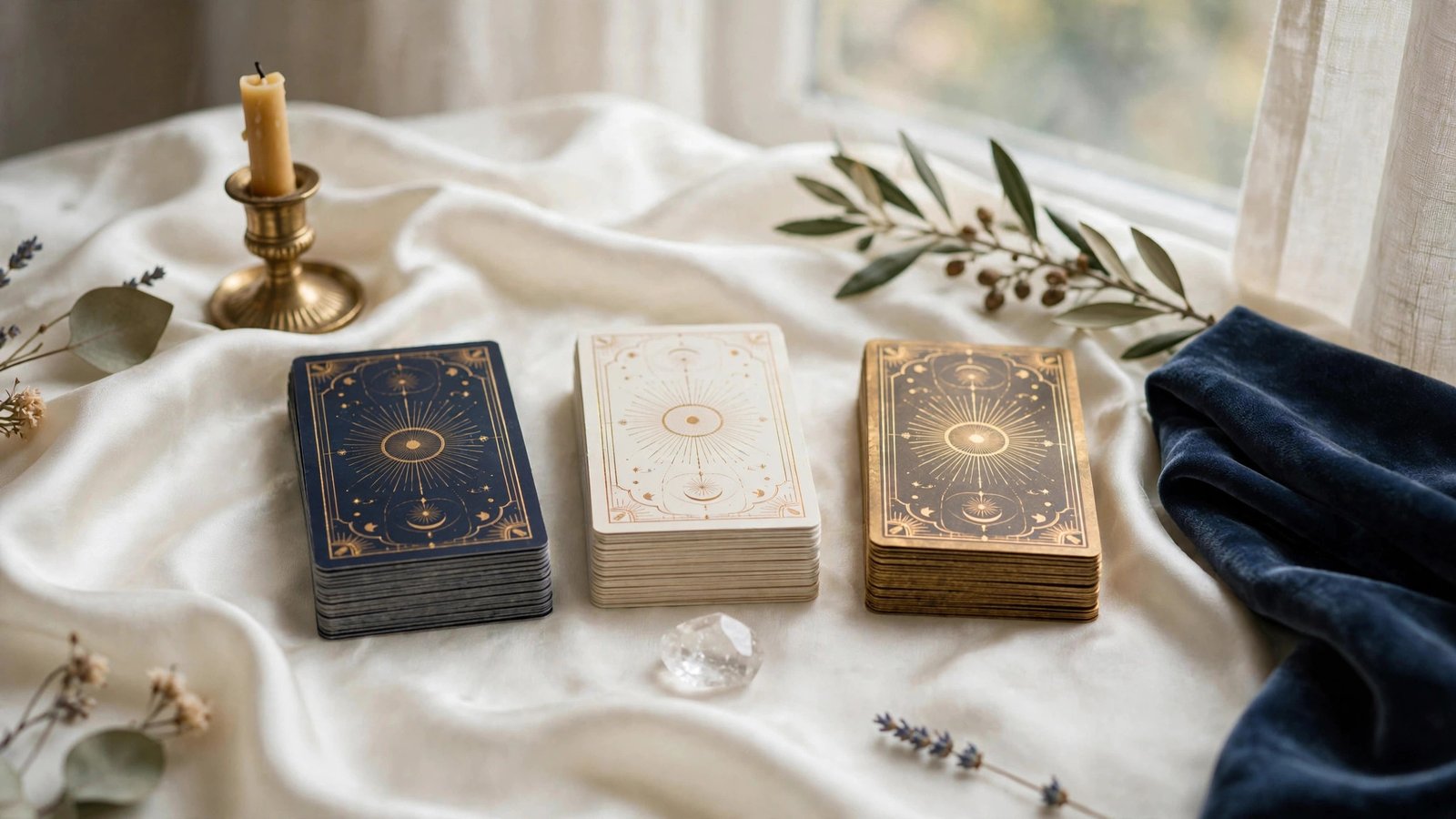
Choosing your first tarot deck feels like a bigger decision than it is. Walk into the world of tarot and you’ll find hundreds of decks — dreamy watercolor decks, stark minimal decks, decks based on the Marseille tradition, decks that look like they fell out of a 1970s record sleeve. When you’re looking for the best tarot deck for beginners, the honest answer is: the one you’ll actually use. But a few practical things genuinely matter, and knowing them saves you from buying a deck that frustrates you off tarot entirely.
Start With the Rider-Waite-Smith System
Most tarot learning resources — books, courses, apps, article series like this one — teach from the Rider-Waite-Smith (RWS) tradition. Pamela Colman Smith’s 1909 illustrations gave nearly every minor arcana card a full scene instead of a bare arrangement of suit symbols. That’s a huge deal for a beginner: you can look at the Five of Cups and see grief in the image rather than trying to decode “five cups” from scratch.
Decks built on the RWS system number in the hundreds, so you can have Smith’s readable structure wrapped in art you love. Your first deck doesn’t need to be the original RWS — it just needs to speak that visual language so the resources you learn from match the cards in your hands.
What to Look for in a Beginner Tarot Deck
- Illustrated minor arcana: Every card should tell a little story. Avoid decks where the minor arcana are just pip patterns (six swords, four wands) — they’re beautiful, but much harder to learn on.
- Readable symbolism: Faces, expressions, postures, landscapes you can respond to. You want cards that make you feel something before you know anything.
- Card size and stock you like handling: You’ll shuffle these constantly. Standard poker-size cards are easiest to shuffle; very large cards look gorgeous but fight you.
- A guidebook that actually explains: Many beginner-friendly decks include booklets with card-by-card meanings, keywords, and spread ideas. A deck with a thoughtful companion book shortens the learning curve dramatically.
- Art that holds your attention: You’ll be staring at these cards a lot. Pick imagery you don’t get bored of — or irritated by — on the hundredth look.
Popular Beginner-Friendly Options
You don’t need a ranking; you need a shortlist of safe, widely loved starting points:
The Original Rider-Waite-Smith
The default textbook deck. Its imagery is familiar, every learning resource references it, and it’s inexpensive. Some find the art dated; others find that charming. As a learning tool, it’s unmatched.
A Modern RWS-Based Deck
Dozens of artists have re-illustrated the RWS scenes in contemporary styles — diverse representation, softer palettes, cleaner lines. If you like the RWS structure but want art that feels like yours, this is the sweet spot.
The Marseille Tradition
The older Marseille decks are beloved by purists, but their minor arcana are unillustrated pips. Wonderful as a second deck; tough as a first one.
What Doesn’t Matter (Ignore the Gatekeeping)
You’ll hear rules: your first deck must be a gift, you must sleep with it under your pillow, you must never buy your own. These are folklore, not requirements. Buy your own deck. Keep it in a drawer. Knock on it if you like — or don’t. The deck is a set of printed images, and its power comes from the reflection you do with it, not from ritual compliance.
Price doesn’t predict usefulness either. A $15 mass-market deck teaches just as well as a $60 indie deck. Spend more only if the art genuinely moves you.
How to Test-Drive a Deck Before Buying
- Look at at least 10–15 card images online, not just the box art — including several minor arcana and court cards, the ones beginners struggle with most.
- Ask: does the art draw you in, or does it feel like homework? Choose draw-you-in.
- Check reviews for card stock quality — flimsy stock that sticks together will annoy you daily.
- If a local shop has sample decks you can handle, shuffle them. Your hands vote too.
Your First Week With the Deck
Don’t try to memorize 78 cards. Instead: pull one card each morning and look at it for two minutes. Notice what’s happening in the image, how the figures feel, what colors dominate. Then read the guidebook entry and see what resonates. By the end of a week, you’ll have a real relationship with seven cards — and a method you can repeat for months. If you’d like a structured place to start, the daily tarot draw pairs each card with a gentle reflection prompt.
When to Get a Second Deck
Give your first deck a few months of regular use before adding another. A second deck is worth it when you want to see familiar meanings through new imagery — comparison teaches faster than any textbook. But one well-used deck beats five shelf decorations every time.
Caring for Your Deck (the Practical Version)
You don’t need silk wraps or moonlight rituals — though you’re welcome to enjoy them if they delight you. Practical care is enough: keep the cards dry, store them in their box or a pouch so edges don’t fray, and wash your hands before long reading sessions if the stock picks up oils. Many readers like to “reset” a new deck by looking through every card once, front to back — not for mystical reasons, but because it builds familiarity fast. Within a week of that first flip-through plus daily one-card pulls, the deck stops feeling like a stranger’s property and starts feeling like a tool you own.
FAQ
Is the Rider-Waite-Smith deck the best tarot deck for beginners?
It’s the safest starting point because nearly every learning resource uses its imagery. Any RWS-based deck with art you love works just as well.
Should my first tarot deck be a gift?
No — that’s a myth. Buying your own deck is completely fine and the most common way people start.
How much should I spend on a first tarot deck?
A solid beginner deck costs roughly $15–$30. Price doesn’t affect how well it works for learning.
Can I learn tarot with a deck that has unillustrated minor arcana?
You can, but it’s significantly harder. Illustrated minor arcana let you read the image before you know the keywords — start there.
Once your deck arrives, the real fun begins: getting to know the cards themselves. Browse the Tarot Library to explore each card’s imagery and meaning at your own pace — no memorization required.