
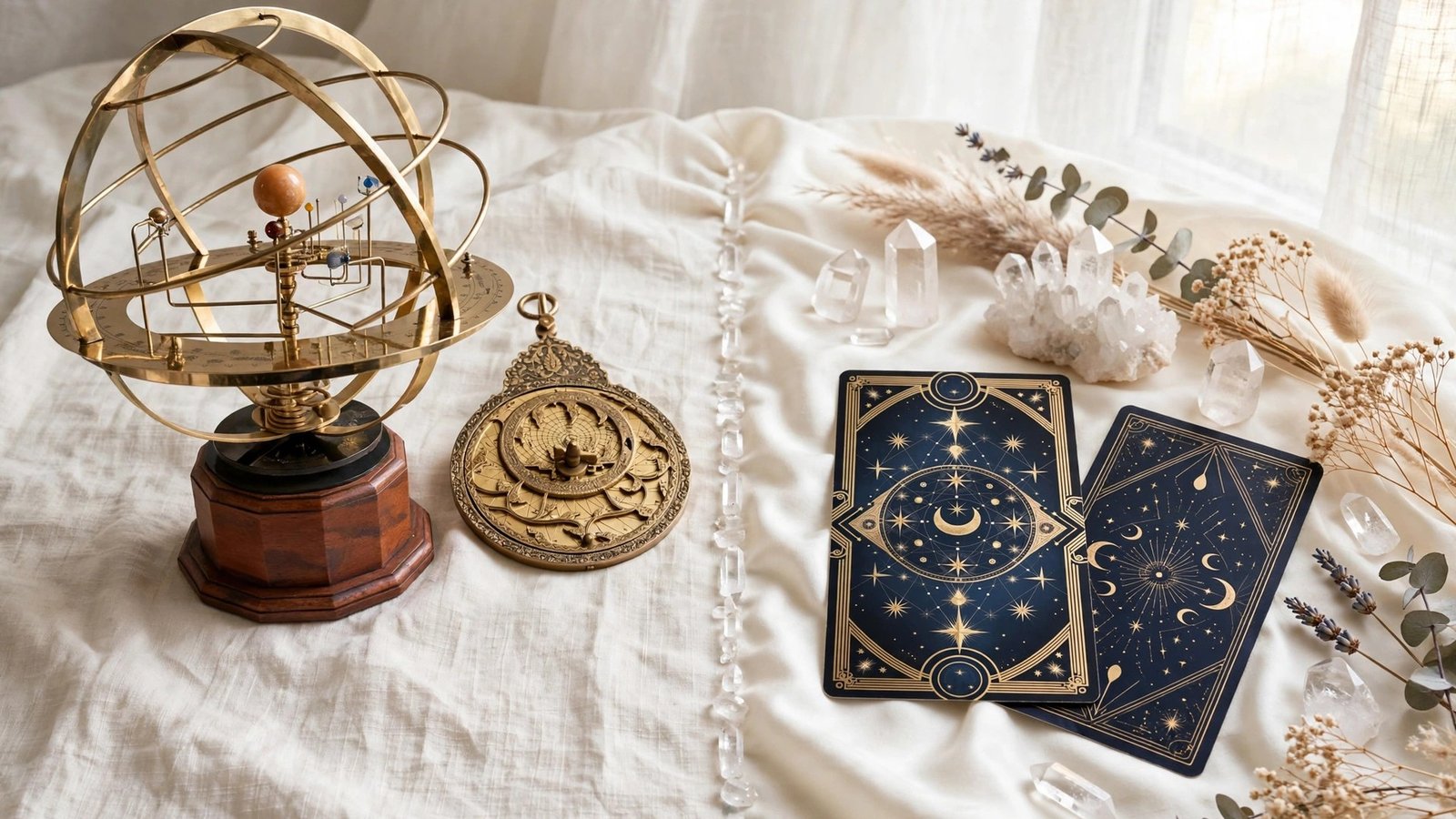
Every result on Astracana — a drawn tarot card, a computed moon sign, a transit date — is made of two completely different things fused together: a calculation and an interpretation. Most confusion, disappointment, and mistrust around astrology and tarot tools comes from mixing these layers up: treating symbolic language as though it were measured fact, or dismissing measured facts because the symbolism feels unscientific. Keeping the two layers distinct makes you a sharper user of every tool here — and a more honest thinker about what these practices can and can’t do.
Layer 1: The Calculation (What Is Fact)
The calculation layer is mechanical. Given inputs, it produces outputs through defined procedures — no intuition, no mystery, no judgment involved. On Astracana, this layer includes:
- Tarot draws. When you pull a card, the selection is made by
Math.random()— the standard pseudorandom number generator built into web browsers. Every card has an equal probability on every draw. That’s it. There’s no “energy” in the code, no weighting toward cards you “need” — just uniform randomness, the digital equivalent of a well-shuffled deck. - Planet positions. Given your birth date, time, and location — computed by tools like our birth chart calculator — our engine computes planetary longitudes: where each planet was along the zodiac. This is astronomy: the same kind of math that powers planetarium software, using a simplified ephemeris (engine v1.1). Positions are approximate to a degree or so — fine for sign and house placement, not for precision astronomy.
- Derived quantities. Moon phase from the Sun–Moon angle, void-of-course windows from aspect geometry, return dates from orbital cycles, numerology reductions from letter/number tables. All procedural, all reproducible: same inputs, same outputs, every time.
You can verify the calculation layer. Draw statistics converge on uniform distribution over many pulls. Planet positions can be cross-checked against any ephemeris. This layer is fact in the ordinary sense: checkable, repeatable, impersonal.
Layer 2: The Interpretation (What Is Symbolic)
The interpretation layer is where meaning enters — and it’s an entirely different kind of thing. It includes:
- Traditional associations. “Saturn relates to structure and limits.” “The Tower suggests sudden change.” These aren’t discovered by measurement; they’re inherited from centuries of symbolic tradition — part philosophy, part poetry, part accumulated human observation about what these symbols tend to evoke.
- Reflection prompts. “What structure in your life needs attention?” This isn’t a claim about reality — it’s a question designed to direct your attention productively. Its value is measured by whether it helps you think, not by whether it’s “true.”
- Synthesized narratives. When a tool weaves your placements into paragraphs, it’s combining traditional associations with your calculated facts using templates written by humans. The output is a reading — closer to an essay prompt than a lab result.
The interpretation layer is symbolic: meaningful, often genuinely useful, but not factual in the scientific sense. “This card points toward a need for rest” is a worthwhile reflection; “this card proves you are exhausted” would be a category error — and we never write the second kind of sentence.
Why the Distinction Matters
Three common mistakes dissolve once you see the two layers:
- “The tool knew things about me!” What felt personal was usually the interpretation layer doing its job — traditional symbolism is broad enough to resonate widely (the Barnum effect is real), and your own mind did the personalizing. That’s not a trick; it’s how reflective tools work. But it’s worth knowing you supplied the specificity.
- “Two tools gave different answers, so it’s all fake.” The calculation layers may differ slightly (different ephemerides, different house systems), but most differences live in the interpretation layer — different authors, different traditions, different templates. Disagreement among interpretations is normal; it’s like two critics reviewing the same film.
- “It’s just random / just math, so it’s meaningless.” This dismisses the interpretation layer because the calculation layer is mechanical. But meaning was never in the random draw — it’s in what the symbol evokes when you reflect on it honestly. A Rorschach blot is “just ink”; the reflection it prompts can still be real.
How Astracana Keeps the Layers Visible
We try to make this distinction structural, not just rhetorical. Every tool result carries a “Why This Result?” footer that explains, in plain language, what was calculated (the inputs, the method, the approximations involved) and what was interpreted (the tradition the meanings come from, and the fact that they’re reflective prompts, not facts). When a result involves uncertainty — an approximate birth time, a simplified calculation — the footer says so explicitly rather than presenting a confident number.
This is a deliberate design choice. We’d rather show you the seams — here’s the math, here’s the symbolism, here’s where one ends and the other begins — than present a seamless oracle. Seams are where honesty lives.
Reading Any Result in Two Passes
A practical habit for every tool on this site: read each result twice. First pass — the facts: what was computed from my inputs? (My moon is at 14° Taurus. I drew the Seven of Cups.) Second pass — the reflection: what does the traditional symbolism invite me to consider? (What does “emotional steadiness” mean for me right now? What are the seven cups I’m choosing among?)
The first pass grounds you; the second pass opens you. Confuse them and you get either false certainty or false dismissal. Keep them distinct and you get the best of both: reliable mechanics and meaningful reflection, each doing what it’s actually good at.
See our methods laid bare: read our Methodology page for the full account of how each tool calculates, what traditions our interpretations draw on, and exactly where we simplify — the complete map of fact versus symbol on Astracana.