
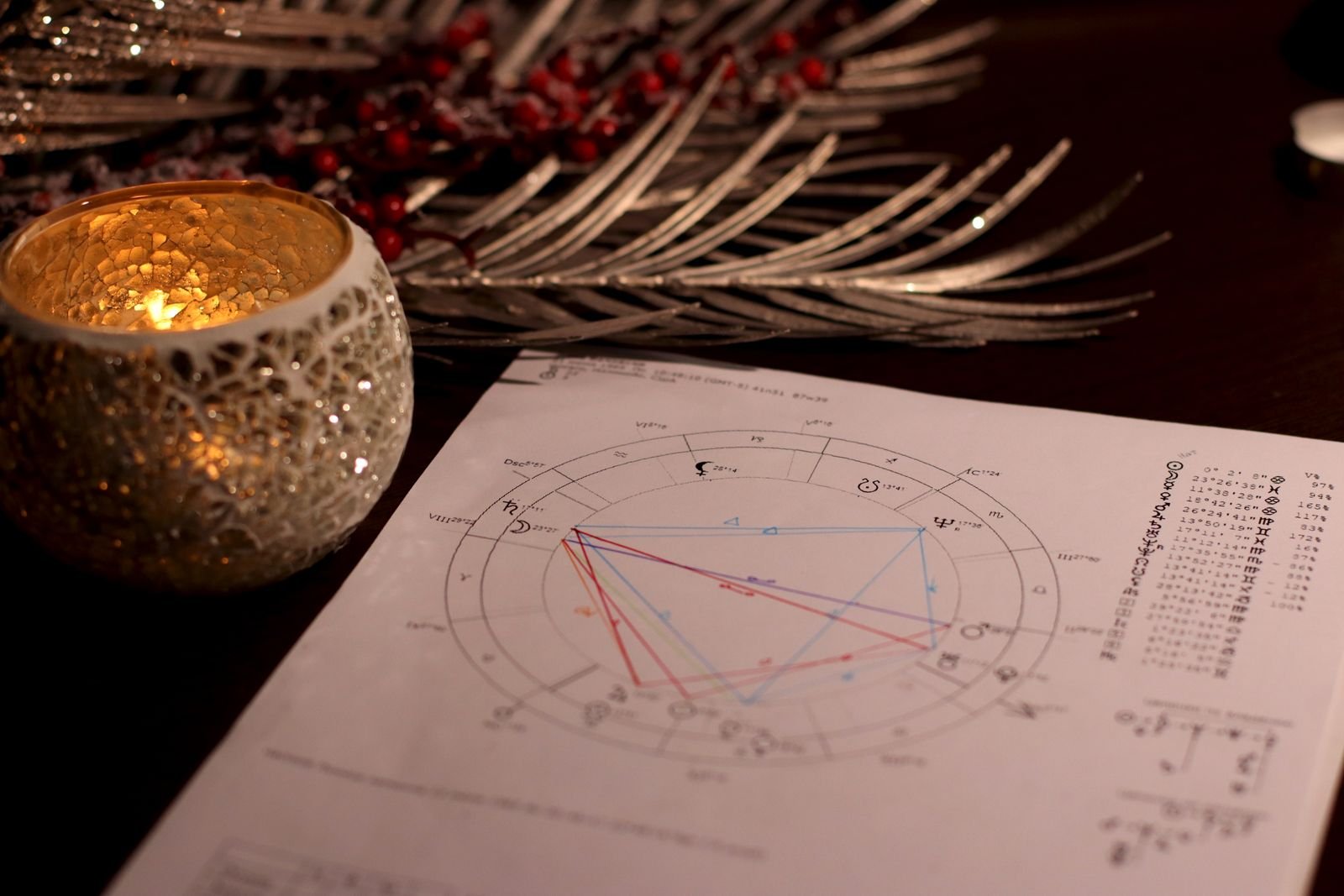
A birth chart looks like a clock that exploded, but you can get a working read of one in ten minutes if you stop trying to read everything. Most beginners freeze because they open a full chart and meet forty symbols at once. The fix is a strict order: three placements first, then the houses, then one aspect. Here is that order, step by step.
Minute one to three: the big three
Start with the Sun sign, the Moon sign, and the rising sign (the ascendant). The Sun sign describes the core drive and the direction a person grows toward. The Moon sign describes the emotional reflexes: what soothes, what rattles, what the person needs when nobody is watching. The rising sign is the mask and the manner: how the person comes across in the first ten minutes of meeting them.
Read them as three sentences. “Leo Sun: needs a stage for self-expression. Pisces Moon: absorbs the room’s mood and needs solitude to drain it off. Virgo rising: comes across as competent and detail-minded.” That is already a recognizable person. These three placements carry more weight than the rest of the chart combined for a quick read, so give them half your time.
Minute four to six: planets in houses
Next, look at which house each personal planet sits in. The simple grammar is: the planet is what, the sign is how, the house is where. Venus is what you love and how you relate; in the seventh house of partnership, that energy shows up directly in relationships. Mars is drive and assertion; in the tenth house of career, the person pushes hardest in their professional life.
You do not need all the planets. In a ten-minute read, stick to the Sun, Moon, Mercury, Venus, and Mars, the planets that describe personality and daily behavior. Note each planet’s sign and house in one line: “Mercury in Scorpio, eighth house: research-grade curiosity about hidden things.” If you keep the planet-sign-house grammar in front of you, each line practically writes itself.

Minute seven to eight: the rising sign’s ruler
Find the planet that rules the rising sign and see where it sits. Aries rising is ruled by Mars; Taurus and Libra by Venus; Gemini and Virgo by Mercury; Cancer by the Moon; Leo by the Sun; Scorpio by Mars and Pluto; Sagittarius by Jupiter; Capricorn by Saturn; Aquarius by Saturn and Uranus; Pisces by Jupiter and Neptune. This planet, the chart ruler, is the chart’s steering wheel: its sign and house show where the person’s life energy gets directed.
A chart ruler in the tenth house points the life toward public work. In the fourth, toward home and family. In the twelfth, toward behind-the-scenes or inner work. This one placement often explains the person’s life direction better than the Sun sign does, and most ten-minute reads skip it.
Minute nine: one loud aspect
Pick the tightest aspect involving a personal planet, meaning the smallest orb, and read it as the chart’s loudest tension or gift. A Sun square Moon (a few degrees of orb) describes a person pulled between their direction and their needs; that tension usually shows up as restlessness that productive work resolves. A Venus trine Jupiter reads as ease in relationships and a generous streak. One aspect is enough. Aspects multiply fast, and the goal is a clear picture, not a complete one.
Minute ten: say it back in plain language
Close by compressing everything into three or four plain sentences, the way you would describe a friend. “She leads with competence, feels everything, and recharges alone. Her ambition goes into her career, and the tightest tension in her chart is between what she wants and what she needs.” No jargon in the summary. If the reading sounds like a person instead of a chart, the ten minutes worked.
What to skip on purpose
Skip the outer planets’ signs (everyone your age shares them), the asteroids, the fixed stars, and every aspect wider than about five degrees. Skip worrying about whether the chart uses the tropical or sidereal zodiac for now; Western charts default to tropical, and the ten-minute method works either way as long as you stay consistent. Depth comes later. The point of the ten-minute read is to build the habit of reading charts in order instead of drowning in them.