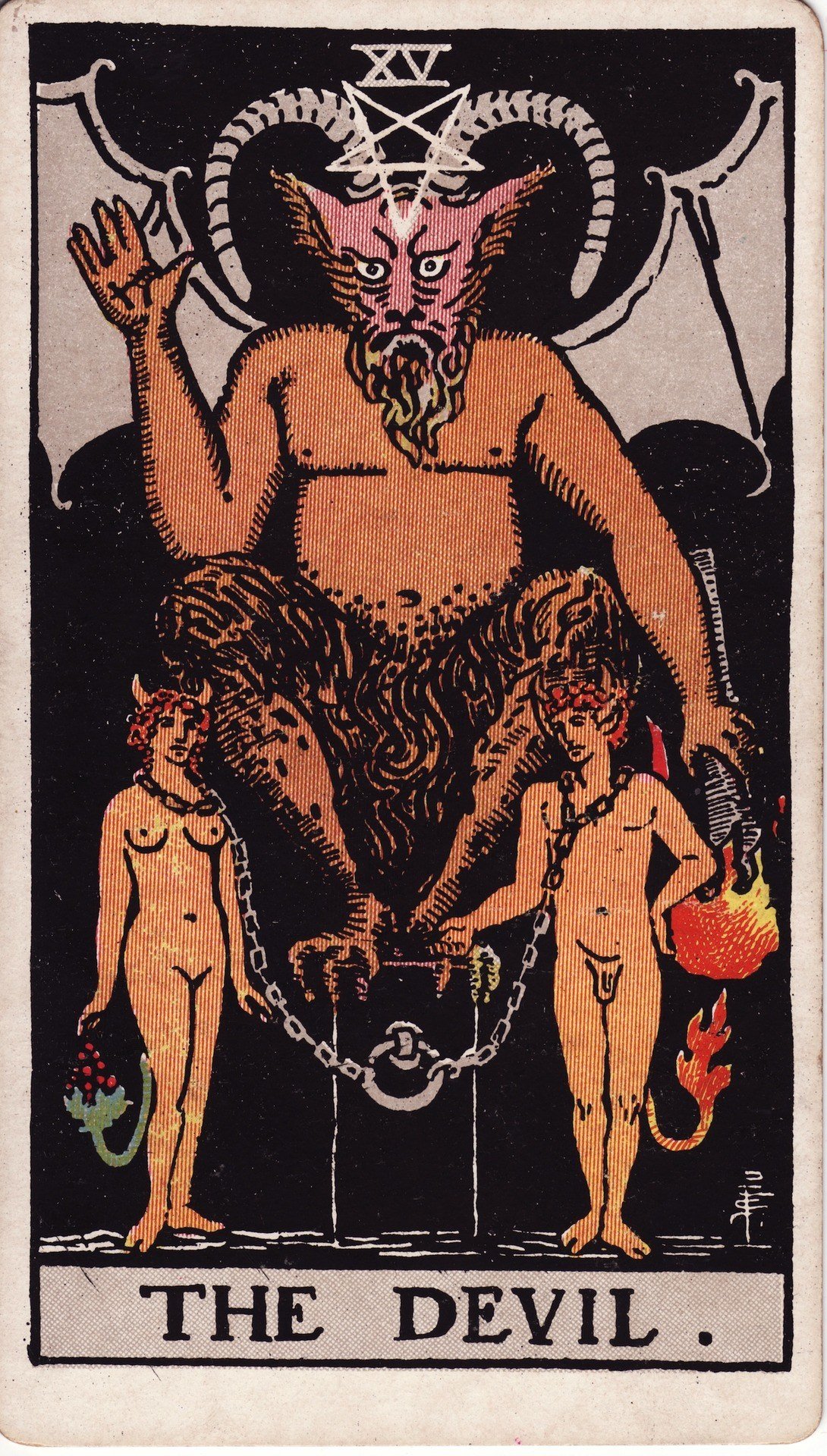
The Devil is the card people least want to see and most need to understand. It looks like a warning about evil, and readers new to tarot often treat it as one. In the tradition, though, the Devil is not about evil at all. It is about attachment: the habits, relationships, appetites, and stories you know are costing you and keep choosing anyway. The card’s question is uncomfortable and simple: what are you chained to, and why are you still holding the chain?
Look at the chains
The Rider-Waite-Smith Devil shows two figures loosely chained to a pedestal. Look closely and the chains are the whole message: they are slack. The loops around the figures’ necks are wide enough to lift off. Nobody is locked in. This is the card’s central honesty, the thing that separates it from cards of real victimhood. The bondage it depicts is voluntary, which is exactly why it is so hard to break. Nobody is keeping you there except the part of you that is afraid of what happens if you leave.
The Devil corresponds to Capricorn, the sign of structure, ambition, and material mastery, which surprises people until they think about it. Capricorn at its best builds lasting things; at its shadow, it mistakes the things for the self. The Devil is materialism as a spiritual condition: believing you are what you own, what you earn, what you consume, who wants you.

What the Devil actually points to
In practice the card names specific attachments. The relationship you would leave if you trusted yourself. The drink, the scroll, the spending, the substance that stopped being fun a while ago. The job that pays for the life that is making you sick. The grudge you rehearse like a favorite song. The card does not judge these; judgment would be easier to dismiss. It just shows them, chained and slack, and waits.
This is also why the Devil appears so often in readings about things going well. Attachment does not require misery. It only requires that your well-being depend on something outside your control continuing exactly as it is. The comfortable trap is still a trap, which is why the Devil sits directly before the Tower in the Fool’s journey: the comfortable attachment, left alone long enough, becomes the structure the lightning eventually hits.
The Devil in love and money
In love readings, the Devil asks about the terms of the bond. Passion is not the problem; the card often appears for intense, magnetic connections. The question is whether both people could leave. Obsession, jealousy, staying for the lease or the fear, a dynamic where desire and dread take turns driving: these are Devil patterns. The card can also describe a healthy intensity honestly named, which is why context and surrounding cards matter more here than anywhere.
For money and work, the Devil is the golden handcuff card. The salary that keeps you in a role you have outgrown. Spending that manages feelings instead of needs. Debt as a lifestyle rather than an emergency. The card’s counsel is practical, not moral: look at what the money is actually buying, and whether you would still want the trade with the receipt in front of you.

Reversed: loosening the chain
The Devil reversed usually means the attachment is loosening. The habit breaking, the relationship ending or renegotiating, the moment of seeing the chain as a chain. It can also mean the shadow going underground: the attachment continuing but hidden, even from yourself. The difference shows in the surrounding cards and, honestly, in the querent’s face when the card turns over. Recognition has a look.
Our guide to the major arcana and the Fool’s journey places the Devil between Temperance and the Tower, which is the whole story in three cards: balance, attachment, release. And our practical guide to all 78 cards covers the card’s traditional meanings in full.
An honest way to work with it
When the Devil appears, try the card’s own method: name the attachment out loud, specifically. Not “I have issues with money” but “I spend when I feel invisible at work.” Not “this relationship is complicated” but “I stay because leaving would mean admitting I chose wrong.” Specificity is the solvent. Chains described precisely start looking liftable, which is exactly what the image has been showing all along. The Devil’s secret, the one the card never hides, is that the door was never locked. You just have to want what is on the other side more than you want the familiar dark.