
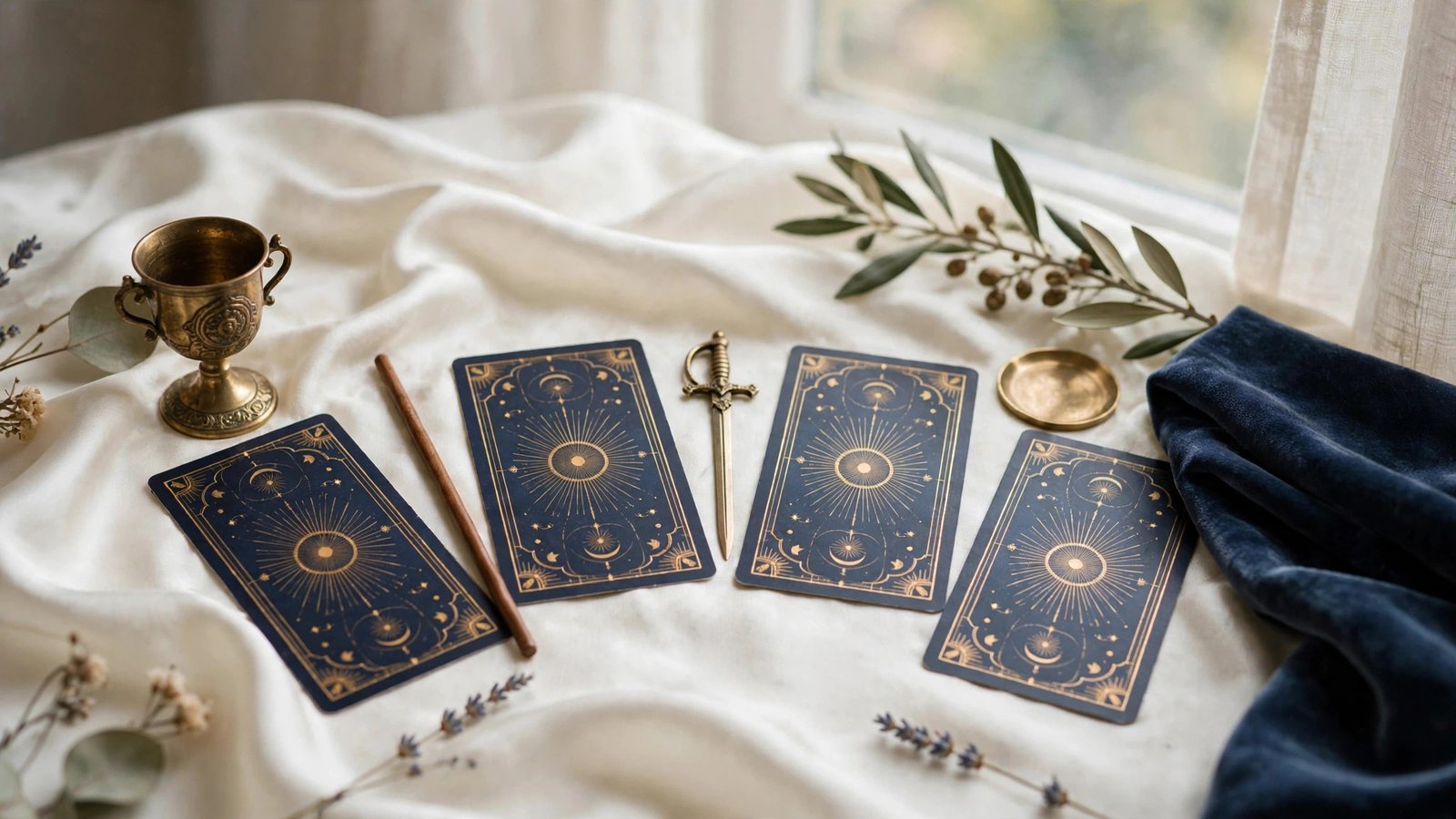
Once you move past the twenty-two Major Arcana, you meet the fifty-six Minor Arcana — the everyday cards of work, love, arguments, celebrations, and quiet Tuesdays. They’re organized into four tarot suits, and understanding tarot suits meaning is the single highest-leverage thing a beginner can learn: it turns fifty-six cards into four ideas with variations.
The Four Suits at a Glance
- Wands — Fire: passion, creativity, ambition, inspiration, drive. The realm of “I want.”
- Cups — Water: emotions, relationships, intuition, love, connection. The realm of “I feel.”
- Swords — Air: thought, communication, truth, logic, conflict. The realm of “I think.”
- Pentacles — Earth: work, money, health, home, the material world. The realm of “I have / I build.”
Each suit runs from Ace (pure potential) through Ten (completion or culmination), plus four court cards. So every suit tells a small story: a spark of the element’s energy, its development through the numbers, and the people who embody it.
Wands: The Suit of Fire
Wands cards point toward energy in motion — the projects you pour yourself into, the ambitions that keep you up at night, the creative sparks and the burnout that follows when the fire burns unchecked. The Ace of Wands is the classic “new idea” card; the Ten of Wands shows the weight of carrying too much.
In readings, a cluster of Wands suggests the question is really about desire and direction: what you want, where your energy is going, and whether your actions match your ambitions.
Cups: The Suit of Water
Cups cards trace the emotional life: new love, deep friendship, heartbreak, healing, contentment. The Two of Cups is partnership and mutual attraction; the Five of Cups holds grief and loss; the Ten of Cups pictures emotional fulfillment and harmony.
A Cups-heavy spread turns the question toward relationships and inner life: how you feel, who matters to you, and what your intuition is quietly saying. These are often the cards people cry over — in the best way.
Swords: The Suit of Air
Swords cards deal with the mind: ideas, communication, decisions, truth — and the anxiety, conflict, and overthinking that come with them. This suit has a reputation for being “the scary one,” but that’s a misunderstanding. The Ace of Swords is clarity and breakthrough; the Six of Swords is moving toward calmer waters; even the Ten of Swords, the rock-bottom card, points toward an ending that clears the way for something new.
Lots of Swords in a reading suggests the situation is really about thinking and communicating: a decision that needs clarity, a truth that needs saying, or a mental loop that needs breaking.
Pentacles: The Suit of Earth
Pentacles cards ground the reading in the tangible: career, money, health, home, craft, the body. The Ace of Pentacles can signal a new job or financial opportunity; the Three of Pentacles celebrates skilled collaboration; the Nine of Pentacles shows self-sufficient prosperity.
A Pentacles-heavy spread asks about security and building: practical resources, long-term plans, and the physical realities of daily life. These cards reward patience — earth moves slowly, but it holds.
How the Suits Interact in a Spread
Single-suit dominance is a message in itself. Mostly Cups? The question is emotional at its core, whatever its surface. Wands and Swords together? Passion and thought in tension — desire pushing one way, logic another. Pentacles alone in a love reading? The relationship may be functioning as a practical arrangement, or security may be the real concern underneath the romance.
Also watch for what’s absent. A career spread with no Pentacles might mean the real issue isn’t the job — it’s the burnout (Wands) or the difficult colleague (Cups). Missing suits point toward blind spots.
The Suit Journey: Ace to Ten
Within each suit, the numbers trace an arc: the Ace offers raw potential, the middle numbers develop and complicate it, and the Ten brings culmination — fulfillment or overload, depending on the suit. The Five of each suit tends to be the crisis point (conflict, loss, struggle), while the Six often begins recovery. Learning this numeric rhythm means you can read any minor arcana card you’ve never studied by combining suit + number — a skill covered in depth in our guide to tarot numerology.
The Suits in Everyday Life
Once the four suits click, you’ll start seeing them everywhere — which is exactly the point. A heated brainstorming session is Wands energy. A long honest talk with a friend is Cups. Drafting a careful email is Swords; cooking dinner or paying bills is Pentacles. This isn’t about forcing tarot onto ordinary life; it’s about noticing that the deck maps the same four realms you already move through daily: desire, feeling, thought, and the material world. When a reading feels abstract, translate it back into these terms: “What would this look like as something I want, feel, think, or build?” The answer is usually immediate — and usually right.
FAQ
What do the four tarot suits represent?
Wands represent fire (passion, creativity, ambition); Cups represent water (emotions, relationships, intuition); Swords represent air (thought, communication, conflict); Pentacles represent earth (work, money, health, the material world).
Which tarot suit is about love?
Cups. It’s the suit of emotions and relationships — though love readings often include cards from other suits too, since real relationships involve passion (Wands), communication (Swords), and shared practical life (Pentacles).
Are Swords always negative in tarot?
No. Swords represent the mind and truth, which includes clarity, breakthrough, and honest communication alongside anxiety and conflict. Context and surrounding cards shape the reading.
How many cards are in each tarot suit?
Fourteen: Ace through Ten plus four court cards (Page, Knight, Queen, King). Four suits × fourteen cards = the fifty-six Minor Arcana.
To explore every card suit by suit — with imagery notes and reflection prompts for each — visit the Minor Arcana Library. And if you want to see how the suits map onto the night sky, the Card + Sky tools explore tarot-astrology connections.