

Ask two Aries what being Aries means and you may get two different answers. One is all charge-forward Mars energy, the other is warmer, prouder, more theatrical. Traditional astrology has an old explanation for this: the decans. Each zodiac sign divides into three ten-degree faces, called decans, and each face carries its own planetary ruler and its own flavor. Once you know your decan, sign-level descriptions stop feeling generic.
What a decan is
The zodiac is a 360-degree circle. Divide it into twelve signs of thirty degrees each, and then divide each sign into three equal slices of ten degrees. Those slices are the decans: thirty-six of them around the wheel. The first decan of a sign covers 0 to 10 degrees, the second covers 10 to 20, and the third covers 20 to 30.
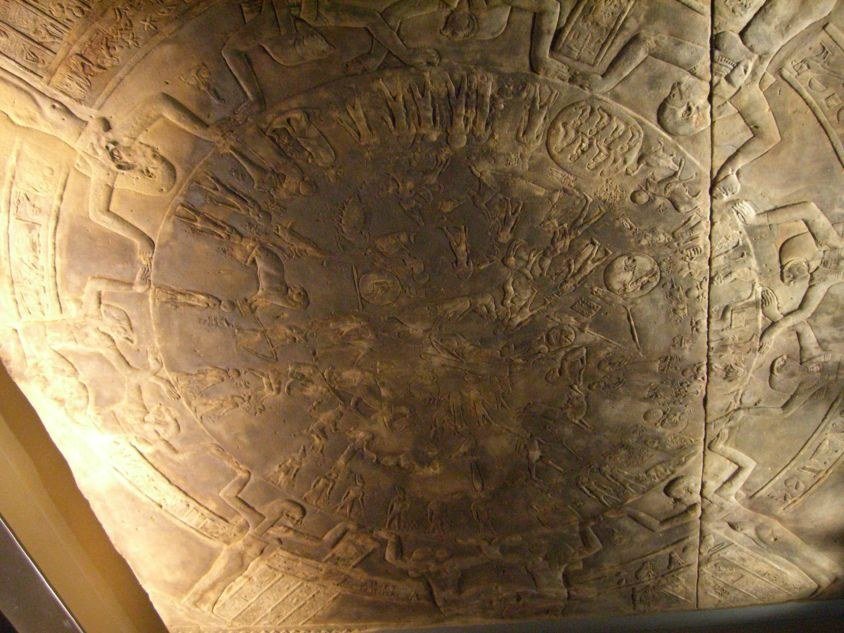
The system is ancient. Egyptian astronomers tracked thirty-six star groups, the original decans, rising in succession through the night to mark the hours, and the idea passed into Hellenistic astrology as a way of subdividing the signs. You can still see the Egyptian roots in artifacts like the Dendera zodiac, a carved stone ceiling from a temple in Egypt that maps the heavens as the ancients understood them. Decans are not a modern invention or a pop-astrology add-on. They are one of the oldest refinements in the tradition.
The chaldean rulers
Each decan has a planetary ruler, and the rulers follow the Chaldean order: Saturn, Jupiter, Mars, Sun, Venus, Mercury, Moon, repeating. The sequence begins with Mars ruling the first decan of Aries, which makes tidy sense since Mars rules Aries itself, and then marches through all thirty-six decans in order.
So the three faces of Aries are ruled by Mars, the Sun, and Venus respectively. Taurus takes Mercury, the Moon, and Saturn. Gemini takes Jupiter, Mars, and the Sun, and so on around the wheel. The decan ruler does not replace the sign ruler. Think of it as an accent: the sign sets the language, and the decan ruler adds a regional dialect.
This is one reason two people with the same Sun sign can read so differently. If your Sun sits at 4 degrees of Aries, you are a first-decan Aries with Mars doubling down on the sign’s own ruler. If it sits at 25 degrees, you are a third-decan Aries with Venus softening and socializing the fire. Same sign, noticeably different expression. A related reason is placement near a sign boundary, which we cover in our piece on planets near sign boundaries.
The three faces of aries, up close
Aries makes the clearest example because its decan rulers are so distinct. The first decan, 0 to 10 degrees, ruled by Mars, is the most purely Arian: direct, physical, impatient with delay, happiest moving. This is the Aries of the stereotype, and it is also the rarest to meet in pure form.
The second decan, 10 to 20 degrees, ruled by the Sun, carries a Leonine warmth. The pioneering drive is still there, but it wants an audience and a cause. Second-decan Aries natives often care more about recognition and leadership than the first decan does, and they tend to be the ones organizing the expedition rather than just sprinting ahead of it.
The third decan, 20 to 30 degrees, ruled by Venus, is the most surprising to people who only know the stereotype. The fire is still lit, but Venus gives it charm, aesthetic sense, and a genuine interest in other people. Third-decan Aries can be the diplomat of the sign, winning the argument with grace instead of force. If your Aries placements never quite matched the “angry ram” description, check whether they sit late in the sign. You may also find our article on why your Sun sign can feel off useful, since decan is one of several common explanations.

How decans refine a chart reading
Decans apply to every planet and point in the chart, the Sun included. Venus in the first decan of Libra expresses partnership in the most classically Libran way, while Venus in the third decan of Libra, ruled by Jupiter, brings a bigger, more generous, more philosophical flavor to relationships. The decan tells you which version of the sign you are dealing with.
In practice, most readers use decans as a second layer, not a starting point. Read the planet in its sign and house first, then let the decan adjust the shading. The decan will not overturn a sign-level reading, but it often explains the part of the reading that felt slightly off. It is also a graceful tool for the common client complaint that sign descriptions feel too broad: the decan gives you something specific to say without inventing anything.
One caution. Decans depend on exact degrees, so they depend on an accurate birth time for house cusps and the Moon, which moves about a degree every two hours. The Sun and slower planets are safe with just a birth date. If you are unsure how much your chart can shift, our comparison of rising sign versus Sun sign explains which placements are time-sensitive and which are not.

